
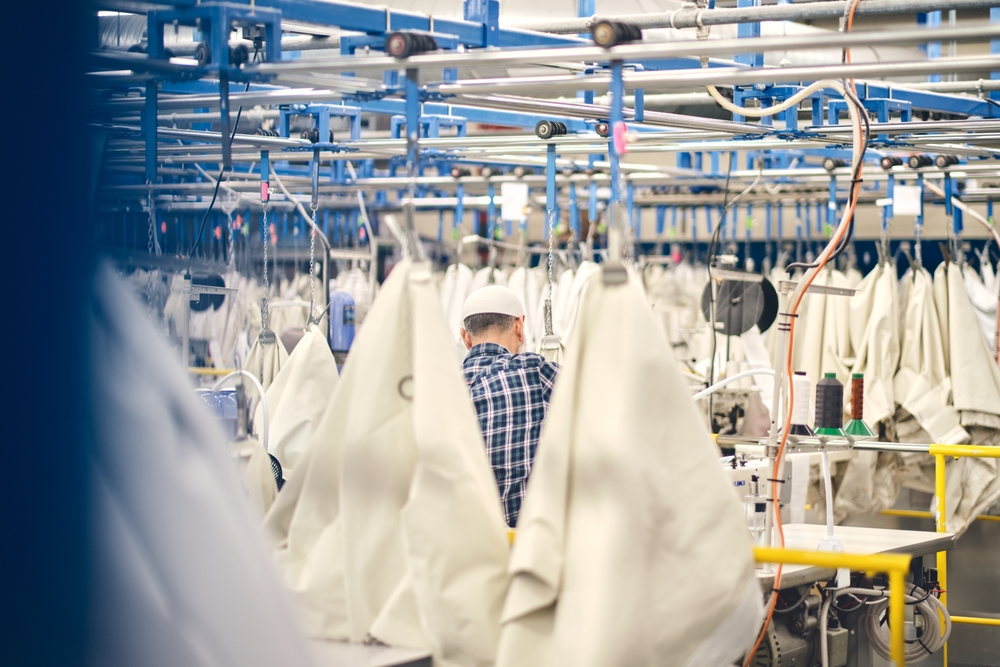
A cutting room only runs as well as the plan behind it. A planner builds a cut order, a marker maker lays out the pieces, and a cutter runs the fabric. On paper, that sounds like three steps in a straight line. In most factories, it is three separate systems that barely talk to each other, and the plan that looked solid on a spreadsheet falls apart the moment someone checks what fabric is actually sitting on the shelf.
This is exactly the gap that PolyPM’s apparel cut order planning software is built to close. PolyPM ties marker plans, spread plans, and step markers directly to the fabric a manufacturer has on hand, connecting its apparel manufacturing ERP software, fashion apparel PLM software, apparel inventory management software, and PolyNest pattern design software into a single apparel production software platform. This article walks through how that connection works and why it matters for cut-and-sew manufacturers.
→ Is your cutting room still reconciling markers against inventory by hand? Ask the PolyPM team how connected cut order planning software closes that gap.
What Is Apparel Cut Order Planning Software?
Apparel cut order planning software is the system a manufacturer uses to decide how much fabric to cut, in what widths, in what lengths, and against which markers, before a single roll hits the cutting table. It takes an order, breaks it down by size and color, and turns that breakdown into a spread plan and a set of markers that a cutting room can actually execute.
At a basic level, this sounds like arithmetic. An order calls for a certain quantity per size, a marker covers a certain size range at a certain fabric consumption, and a planner divides one by the other to get spread lengths and ply counts.
In practice, it is far messier. Fabric arrives in rolls of inconsistent length. Dye lots do not always match across rolls. Shrinkage varies by fabric batch. A marker that was accurate during sampling may not reflect the actual roll widths sitting in the warehouse. Cut order planning software has to account for all of that, not just the order quantity on paper, and PolyPM was designed around that reality rather than around a simplified formula.
Manufacturers who still plan cuts in spreadsheets tend to treat this as a one-time calculation. A planner pulls a fabric consumption figure, multiplies it against order quantity, and issues a cut ticket. When the fabric on hand does not match that assumption, the cutting room either runs short mid-spread or over-cuts and ties up fabric that another style needed. PolyPM’s apparel cut order planning software is built to remove that guesswork by keeping the plan connected to real inventory instead of a static estimate.
→ Are cut tickets in your factory still based on assumptions instead of actual fabric counts? Talk to PolyPM about a system built to close that gap.

Why Do Most Cutting Rooms Struggle Without Connected Planning Software?
Most of the friction in a cutting room does not come from the cutting itself. It comes from everything that happens before the fabric ever reaches the table, and it is why so many manufacturers eventually go looking for a dedicated cut order planning software instead of patching together spreadsheets.
Markers and inventory live in different systems. Markers are built in CAD or marker tools while inventory sits in spreadsheets, warehouse systems, or general ERP software. Without a single view, planners must manually check both before cutting, and that check is often skipped when schedules get tight.
Roll lengths never match the plan perfectly. A spread plan based on average roll lengths can fail when actual rolls arrive shorter, longer, or across multiple deliveries. Without a live connection to inventory, planners discover the mismatch on the cutting floor instead of beforehand.
Step markers are built once and reused blindly. Step markers combine sizes to improve fabric utilization, but only work when the size mix matches the order. When the mix changes without updating the marker, factories may cut unwanted sizes or run multiple spreads unnecessarily.
Fabric shortages surface too late. A planner may not discover that a dye lot or roll length cannot cover a spread until the order is already committed to a ship date. Last minute purchasing, air freight, or partial shipments then erode margins.
Change orders break the plan silently. Style changes, size mix adjustments, or substitutions can invalidate markers or spread plans without being flagged. When cut order planning is disconnected from product data, changes can reach the cutting room unnoticed.
None of these problems are caused by bad planners. They come from systems that were never built to work together, which is why PolyPM approaches apparel cut order planning software as one connected discipline rather than a spreadsheet exercise bolted onto a generic ERP.
→ Do fabric shortages keep surfacing after the cut order is already committed? Contact PolyPM to see how integrated planning catches that earlier.
How Does PolyPM’s Cut Order Planning Software Actually Work?
PolyPM approaches cut order planning as one continuous process rather than a series of handoffs. The system pulls the order, the bill of materials, the available fabric inventory, and the marker data into the same environment, so a planner is never comparing numbers across three separate tools.
Marker plans start from real product data. Because PolyPM runs Fashion Apparel PLM Software and ERP together on a single database, the size range, colorways, and bill of materials attached to a style are the same data the cut planner sees. A marker plan is not rebuilt from scratch or re-keyed from a separate system. It is generated from the specifications that were already approved during product development.
Spread plans reflect actual roll inventory. Instead of assuming a standard roll length, PolyPM checks Apparel Inventory Management Software records down to the roll and dye lot level. A spread plan built in PolyPM accounts for the real lengths, widths, and shrinkage factors of the fabric that is physically on the shelf, not the fabric that was ordered on a purchase order weeks earlier. This is part of why manufacturers researching textile production software options often end up comparing systems on exactly this point, since a plan that ignores actual roll data tends to fall apart at the cutting table.
Step markers adjust to order size mixes. When an order’s size breakdown shifts, a planner can reconfigure the step marker inside PolyPM without leaving the system, and the fabric consumption and spread length recalculate automatically. This keeps fabric utilization high even when order mixes are irregular, which is common in programs with roster sizing, private label runs, or customer-specific size curves.
Cut plans stay tied to Work in Progress. Once a cut order is released, PolyPM tracks the resulting bundles through Work in Progress, so the cutting room, sewing floor, and finishing operations are all working from the same order record. Planners can see cut-to-order variance immediately instead of discovering it during a WIP audit days later.
→ Would your team benefit from spread plans that reflect real roll inventory instead of assumed yardage? Ask PolyPM how that connection actually works.
How Does the PolyNest and AccuMark Round Trip Fit Into PolyPM’s Cut Order Planning?
This is the part of apparel cut order planning software that most platforms simply do not offer, and it is one of the clearest reasons manufacturers evaluate PolyPM alongside their existing marker making tools instead of replacing them outright.
Many manufacturers already have patterns, grading, and markers built in Gerber AccuMark or a comparable CAD system. Ripping that out and starting over in a new tool is rarely realistic, and it is not what PolyPM asks anyone to do. Instead, PolyPM’s PolyNest Pattern Design Software is built to move data back and forth with AccuMark and similar systems through a genuine round trip, not a one-way export.
Patterns and markers move in both directions. Patterns graded in AccuMark can be imported into PolyNest for marker making, nesting, and fabric utilization, while refined markers can move back in formats cutters and plotters already read. Manufacturers do not need to rebuild their pattern design library.
Marker data feeds the cut order without duplicate entry. Once finalized, fabric consumption, size ratio, and marker length flow into PolyPM’s cut order planning instead of being manually retyped, reducing common transcription errors.
Step markers in PolyNest respect real fabric width. PolyNest accounts for usable fabric width, including selvage loss, so reported marker efficiency reflects what the cutting room can actually achieve rather than a theoretical width.
DXF import keeps pattern geometry accurate. PolyNest interprets DXF imports as true curves, keeping armholes, necklines, and other curved edges accurate through grading and marker making while improving fabric utilization.
This round trip between PolyNest and AccuMark, feeding directly into PolyPM’s apparel cut order planning software, connects the pattern, marker, inventory, and cutting processes in one place. ERP systems typically stop at the order level, while standalone marker tools lack warehouse visibility. PolyPM connects both halves.
→ Already using AccuMark for patterns and markers? Find out how PolyPM’s round trip keeps that investment while adding real cut order planning.
How Does PolyPM Fit the Cut Plan to Fabric You Actually Have on Hand?
Fitting a cut plan to fabric on hand sounds simple until a manufacturer tries to do it across multiple styles, dye lots, and partial rolls at once. This is where PolyPM’s apparel cut order planning software either proves its value or, in a disconnected system, falls short.
Roll-level visibility replaces bulk fabric counts. A generic inventory system might show that a manufacturer has three hundred yards of a fabric on hand. That number is close to useless for cut planning if it is spread across eight rolls of varying lengths and two different dye lots. PolyPM tracks fabric at the roll level, so a planner building a spread plan can see exactly which rolls are available, how long each one is, and which dye lot each belongs to before committing a marker to the cutting table.
Shortage alerts happen before the cut order is released, not during it. When a spread plan requires more fabric than what is currently on hand, PolyPM flags the shortfall immediately rather than letting a planner discover it once the cutting room is already set up. That early warning gives purchasing time to expedite a delivery or gives production planning time to resequence the order, instead of forcing a rush decision on the floor.
Partial rolls and remnants get accounted for instead of ignored. Many cutting rooms treat partial rolls as unusable and let them accumulate as waste. PolyPM’s roll-level inventory visibility can identify which remnants are long enough to cover a smaller cut, a sample run, or a repeat order, recovering fabric that would otherwise sit in a corner of the warehouse.
Dye lot matching prevents shading mismatches after the fact. Fabric dye lots can vary enough to be visible in a finished garment, especially in solid colors. By tracking dye lot at the roll level, PolyPM helps planners avoid mixing lots within a single cut unless the tolerance has been explicitly approved, which prevents shading complaints and returns after shipment.
Marker efficiency and available yardage are evaluated together. A marker with excellent fabric utilization is still a problem if it does not fit the actual roll widths on hand. PolyPM evaluates marker efficiency against real available yardage rather than treating them as two separate calculations, so the spread plan a planner approves is one the cutting room can actually execute without adjustment.
According to a supply chain waste study from the Bren School at UC Santa Barbara, some apparel brands already report fabric-cutting efficiency in the high eighty percent range, and the researchers note that once cutting efficiency approaches that level, additional gains become harder to find through marker adjustments alone. That finding lines up with what PolyPM’s own implementation work shows: once markers are reasonably efficient, the bigger opportunity is making sure the plan matches the fabric that is actually available, not squeezing another fraction of a percent out of the nest itself.
→ Curious how much fabric is tied up in remnants your current system cannot see? Contact PolyPM to talk through roll-level visibility.
Why Is Marker Integration PolyPM’s Biggest Differentiator?
Plenty of apparel ERP platforms offer some version of production planning. Plenty of pattern design tools offer some version of marker making. Very few offer both connected in a way that actually changes how a cutting room operates day to day, which is exactly why marker integration has become one of the clearest reasons manufacturers choose PolyPM over a generic Apparel Manufacturing ERP Software platform.
Most ERP platforms treat marker efficiency as a manual entry. Someone types fabric consumption from a marker built elsewhere. If the marker changes and the ERP is not updated, cut order planning works from stale data.
Most standalone marker tools have no inventory awareness. A pattern and marker system can nest pieces efficiently without knowing whether the required fabric is actually in the building. That disconnect creates plans that look efficient on screen but fail at the cutting table.
PolyPM and PolyNest share the same underlying data. Because PolyNest was built within the same platform family as PolyPM’s ERP and PLM, marker data, fabric consumption, and roll inventory are part of the same operational picture rather than being synced between separate systems, a distinction we cover in more detail when comparing PolyPM against other apparel ERP platforms.
This connection scales across multiple facilities and subcontractors. Manufacturers operating across locations such as Guatemala City, San Pedro Sula, or Tegucigalpa need cut order planning that reflects fabric at each site. PolyPM keeps inventory, markers, and cut orders in one system, extending that visibility across the network.
This is why cut order planning rarely has its own dedicated resource on apparel software sites. Most platforms are strong on either ERP or pattern and marker management. PolyPM’s apparel cut order planning software connects both because PolyPM builds both sides of the equation.
→ Tired of comparing marker efficiency reports against inventory spreadsheets by hand? Talk to PolyPM about a system that already connects the two.
What Other Apparel Manufacturing Software Does PolyPM Offer Beyond Cut Order Planning?
Cut order planning does not exist in isolation, and neither does PolyPM. Manufacturers who adopt PolyPM’s apparel cut order planning software are usually running it inside a wider platform that manages the rest of the manufacturing lifecycle.
PolyPM’s Apparel ERP. The Apparel Manufacturing ERP Software manages order management, purchasing, production scheduling, material requirements planning, costing, shipping, and financial workflows on the same database that drives cut order planning.
PolyPM’s Fashion Apparel PLM. The Fashion Apparel PLM Software handles style management, line planning, bill of materials, tech packs, colorways, measurements, and sample management, so the product data behind a cut order was never re-keyed from scratch.
PolyPM’s Apparel Inventory Management. The Apparel Inventory Management Software tracks raw materials, roll-level fabric, trims, and finished goods with real-time visibility, which is the same inventory layer that powers PolyPM’s cut order planning.
PolyPM’s Apparel Production Software. The Apparel Production Software covers production scheduling, bundle tracking, shop floor management, subcontractor management, and decoration processes such as embroidery and screen printing.
PolyNest Pattern Design Software. PolyNest handles pattern design, grading, marker making, and fabric utilization, feeding marker data directly into PolyPM’s cut order planning without duplicate entry.
Manufacturers comparing this against a patchwork of point solutions often find the real cost difference shows up in how much manual reconciliation disappears once apparel order management, inventory, and production planning share one database instead of three.
→ Curious how cut order planning fits alongside PolyPM’s ERP, PLM, and inventory tools? Contact PolyPM for a walkthrough of the full platform.
Which Industries Does PolyPM’s Cut Order Planning Software Support?
Cut order planning matters most in operations where fabric variation, size complexity, or production volume make manual reconciliation impractical, and PolyPM was built with these segments specifically in mind.
Uniform and workwear manufacturers running repeat programs with high SKU counts and strict compliance specifications rely on PolyPM’s uniform ERP and workwear ERP capabilities to keep size curves and roster requirements aligned with fabric on hand across long production runs, including safetywear compliance needs.
Sportswear and activewear manufacturers working with roster-based numbering and fast turnaround windows use PolyPM to build step markers that adjust quickly as team or event orders shift, without waiting for a planner to rebuild a marker from scratch.
Swimwear and fashion manufacturers managing dozens of colorways per season depend on PolyPM’s dye lot visibility to avoid shading mismatches, a challenge that becomes far harder to catch manually as colorway counts increase.
Denim and outerwear manufacturers working with heavier, wider, or more expensive fabric feel fabric waste more acutely per yard, which makes PolyPM’s marker efficiency and roll-level fitting a larger share of overall margin.
Textile mills and garment manufacturers running high-volume cut-and-sew operations use PolyPM’s textile industry ERP and garment manufacturing ERP tools to keep cut plans, fabric allocations, and production schedules connected across facilities.
Private label and contract manufacturers juggling multiple customers and multiple fabric bases at once use PolyPM to keep cut plans, fabric allocations, and customer specifications separated cleanly across programs running in parallel, a use case covered in more depth on PolyPM’s apparel industry ERP page.
Across all of these segments, the manufacturers who benefit most from PolyPM’s apparel cut order planning software are the ones who have outgrown the point where a spreadsheet and a planner’s memory can keep marker plans, spread plans, and fabric inventory in sync.
→ Does your production mix make manual cut planning harder every season? Contact PolyPM to talk through what connected planning could look like for your operation.
Where Does PolyPM Support Apparel Manufacturers With Cut Order Planning Software?
PolyPM’s apparel cut order planning software is deployed across manufacturers operating in the United States, Canada, Mexico, Central America, South America, Europe, and Asia, which matters because cutting rooms in different regions rarely run the same fabric, the same volumes, or the same compliance requirements.
In the United States, PolyPM supports manufacturers in hubs including Los Angeles, New York, Miami, Chicago, Houston, and Greenville, where uniform, activewear, and private label programs often run alongside each other inside the same facility.
In Canada, PolyPM works with manufacturers based in Toronto and Montreal managing cut-and-sew operations that ship across North American supply chains.
Across Central America, PolyPM supports contract manufacturers in Guatemala City, San Pedro Sula, Tegucigalpa, San Salvador, and Managua, where nearshore production programs depend on cut order planning that reflects fabric availability at each facility rather than a single warehouse.
Because PolyPM runs cut order planning, inventory, and production on one platform regardless of location, manufacturers operating across multiple countries and multiple cutting rooms can see fabric on hand and marker efficiency the same way at every site.
→ Running cutting rooms across more than one country or facility? Ask PolyPM how cut order planning stays consistent across every site.
Final Thoughts on PolyPM’s Apparel Cut Order Planning Software
Cutting rooms rarely fail because planners do not know their job. They fail because the tools around them were never built to share information. A marker built in one system, an inventory count tracked in another, and a cut order issued from a third leaves too much room for the plan to drift away from reality before the fabric ever reaches the table.
PolyPM’s apparel cut order planning software removes that drift at the source by linking PolyNest’s marker making directly to ERP inventory and production, including a genuine round trip with AccuMark for manufacturers who already rely on it. For manufacturers ready to stop reconciling markers against inventory by hand, PolyPM is worth a closer look.
→ Ready to see how PolyPM’s apparel cut order planning software could work inside your own cutting room? Contact the PolyPM team to schedule a walkthrough.
→ Follow PolyPM on LinkedIn for ongoing updates on apparel ERP, apparel PLM, and cut order planning software.

Frequently Asked Questions: PolyPM’s Cut Order Planning Software
What is PolyPM’s apparel cut order planning software?
PolyPM’s apparel cut order planning software is the system manufacturers use to convert an order into a spread plan and marker set, calculating how much fabric to cut, in what widths and lengths, based on order quantities, size mixes, and PolyPM’s live fabric inventory records.
How is PolyPM’s cut order planning software different from general production planning tools?
General production planning tools schedule work and track capacity but rarely have roll-level fabric detail or marker data built in. PolyPM connects marker efficiency, spread lengths, and fabric inventory specifically for cut-and-sew operations, which generic planning tools are not built to handle.
What is a step marker, and how does PolyPM use it in cut order planning?
A step marker combines multiple sizes into a single marker layout to improve fabric utilization. PolyPM lets planners reconfigure step markers as order size mixes change, so fabric consumption and spread length recalculate automatically instead of forcing extra spreads or wasted fabric.
Can PolyPM work with AccuMark, or does it require replacing existing marker tools?
PolyPM’s PolyNest supports a round trip with AccuMark and similar CAD systems, so manufacturers can keep existing pattern libraries and marker tools while gaining PolyPM’s connected cut order planning rather than rebuilding everything from scratch.
How does PolyPM’s cut order planning software prevent fabric shortages?
PolyPM checks spread plans against real roll-level inventory before a cut order is released, flagging shortfalls early enough for purchasing or scheduling to react, instead of discovering the shortage once the cutting room is already set up.
Does PolyPM’s cut order planning software help with dye lot matching?
Yes. PolyPM tracks fabric at the roll level along with dye lot information, so planners can avoid combining mismatched lots within a single cut unless a tolerance has been approved, which reduces shading issues after garments are finished.
Which industries does PolyPM’s cut order planning software support?
PolyPM supports uniform, workwear, sportswear, swimwear, denim, outerwear, textile, garment, and private label manufacturers, since these segments combine high size or colorway complexity with fabric costs that make waste and shortages expensive.
How does PolyPM connect cut order planning to costing and scheduling?
In PolyPM, marker consumption feeds directly into costing so cost sheets reflect actual fabric usage, and cut plans are visible alongside production scheduling so cutting room capacity is considered before a spread plan is finalized.