
Choosing the best garment production tracking software is rarely as simple as picking the most popular name on a review site.
Every apparel manufacturer runs production differently. Some cut and sew everything in house. Others rely on a network of subcontractors spread across several countries. Some need barcode scans on every bundle. Others just need a clear picture of what left the cutting room and what is still sitting on a sewing line.
This guide compares six systems that manufacturers use to track garment production, from cutting through packing.
PolyPM is included first because it connects production tracking with ERP, PLM, inventory, and shipping in one platform, but the right answer for your factory depends on your size, your workflows, and how much shop floor detail you actually need.
By the end of this article you will have a practical framework for evaluating the best garment production tracking software rather than a single recommendation that ignores how your operation actually runs.
What Is Garment Production Tracking Software?
Garment production tracking software gives manufacturers visibility as garments move through every stage of the cutting and sewing process. That typically includes cutting, bundling, sewing, embellishment, quality control, finishing, and packing before shipment.
The strongest garment production tracking software does more than log a status update. It connects what is happening on the floor with the materials being consumed, the styles and BOMs behind each order, and the customer commitments tied to each shipment date.
Without that connection, a production manager can see that a line finished 400 units today but still has no idea whether the correct fabric lot was used or whether the order is actually on pace to ship.
Apparel production is different from general manufacturing because it involves hundreds of small components, frequent style changes, multiple sizes and colorways, and labor-intensive sewing operations that shift from order to order.
A generic manufacturing execution system built for automotive or electronics assembly rarely accounts for bundle tickets, dye lots, or subcontracted embellishment work. That is why manufacturers researching garment production tracking software usually end up comparing apparel-specific systems rather than horizontal MES platforms.
→ Are your teams still tracking work in progress on spreadsheets or paper tickets? Talk to the PolyPM team about connecting your cutting room, sewing floor, and shipping department in one system.
What Should the Best Garment Production Tracking Software Monitor?
Before comparing systems, it helps to define what production visibility actually means on a cut-and-sew floor. Most manufacturers evaluating the best garment production tracking software options need to see the following in real time or close to it.
- Production order status from release through completion
- Units and bundles moving through each operation
- Work in progress (WIP) by operation, line, or facility
- Operator and line activity, including productive and nonproductive time
- Materials issued and consumed against each order
- Damage, defects, and quality holds
- Subcontracted work sent out and returned
- Planned output compared against actual output
- Finished quantities ready for packing
- Shipment readiness against customer ship dates
Some manufacturers only need a few of these data points. A small private label cutter with two sewing lines does not need the same depth of labor reporting as a 500-operator facility running incentive pay. That is an important consideration when you evaluate garment production tracking software, because more features are not automatically better if your team will never use them.
How We Compared the Best Garment Production Tracking Software Systems
To build this comparison, we looked at publicly available product information, vendor documentation, and independent research into how each system is positioned for apparel and sewn products manufacturing.
We evaluated each platform against the following criteria:
- Apparel-specific functionality rather than generic manufacturing features
- Unit, bundle, or production-order level tracking
- Barcode, QR, RFID, or mobile data collection
- Real-time work in progress visibility
- Operator and production line visibility
- Quality and defect tracking
- Subcontractor tracking
- Material and Bill of Materials integration
- Production planning capability
- ERP and PLM integration
- Reporting and dashboard depth
- Multi-facility support
With those criteria in mind, here are six systems manufacturers commonly evaluate when searching for garment production tracking software.
→ Struggling to compare production tracking features against your actual factory workflow? Ask PolyPM how a connected apparel ERP and PLM platform handles bundle tracking, subcontractors, and shipment readiness.
6 Best Garment Production Tracking Software Systems Compared
1. PolyPM
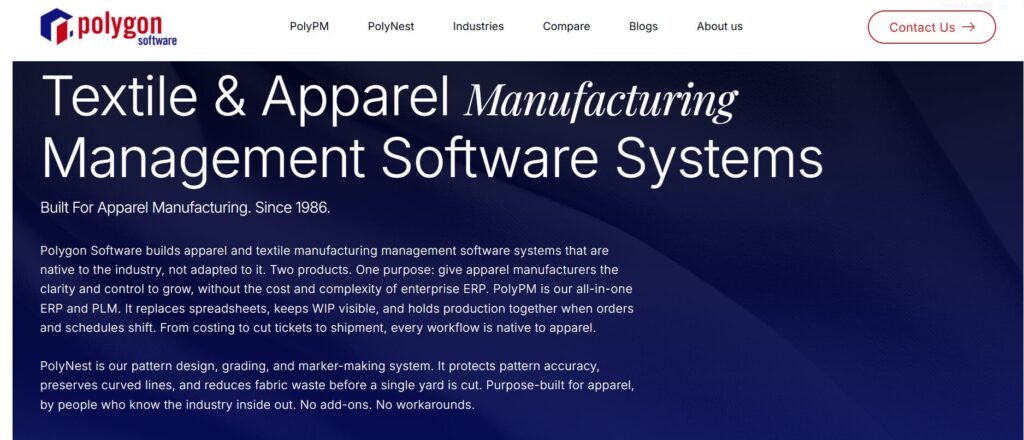
Website: polypm.com
Best garment production tracking software for: Apparel and garment manufacturers that want production tracking connected with ERP, PLM, inventory, cutting, costing, and shipping in a single platform.
PolyPM tracks production by unit, bundle, or complete production order, giving manufacturers flexibility depending on how detailed their shop floor reporting needs to be. Shop floor barcode transactions update production order status directly inside the system, so managers are not waiting on a paper report from the floor to know where an order stands.
PolyPM’s production tracking connects with several other parts of the manufacturing process, including:
- Bundle-level WIP through sewing operations
- Material withdrawals and consumption tied to cutting and manufacturing orders
- Subcontractor visibility for embellishment, sewing, or finishing sent outside the facility
- Damage and quality tracking at the operation level
- Finished-goods allocation once units complete production
- Packing and shipment readiness tied to customer orders
Because PolyPM’s Apparel Production Software shares data with the Apparel Manufacturing ERP Software and Fashion Apparel PLM Software modules, a style’s BOM, tech pack, and costing information flow directly into production without duplicate data entry. That means a production order is never disconnected from the style specification or the materials it consumes.
An important distinction on PolyNest. PolyNest is not production tracking software. PolyNest handles pattern design, grading, marker making, and cutting preparation before production begins. PolyPM handles the manufacturing orders, WIP, materials, and production execution that happen once cutting is complete. Manufacturers researching garment production tracking software sometimes confuse pattern design systems with shop floor tracking systems, so it is worth keeping the two separate when comparing vendors.
2. BlueCherry Shop Floor Control
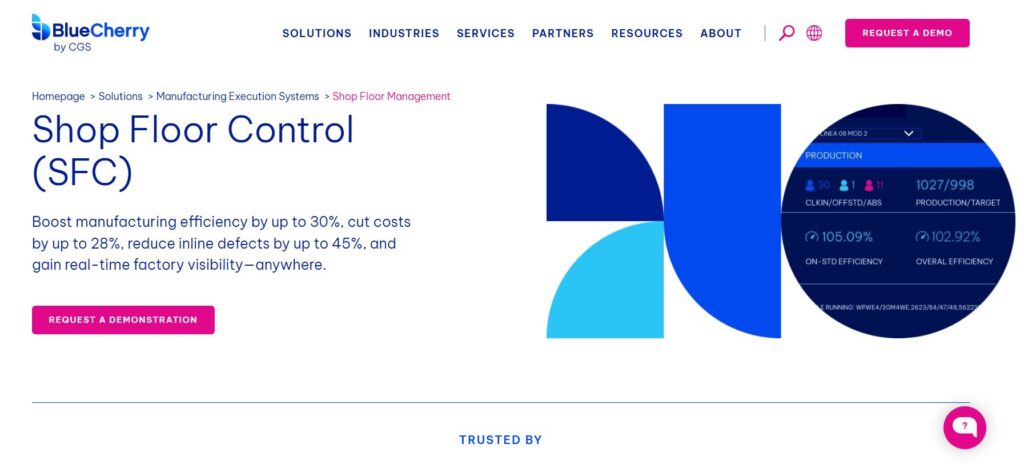
Website: bluecherry.com
Best garment production tracking software for: Apparel and sewn products manufacturers seeking a dedicated shop floor control or MES system.
BlueCherry Shop Floor Control focuses on real-time visibility into production activity at the operator, line, and facility level. Because traditional apparel factories often rely on paper tickets or end-of-day updates, BlueCherry positions its system around letting operators capture work in seconds through terminals or wearables to close that reporting gap. The platform gives managers access to KPIs, WIP, and production milestones through a mobile app or dashboards on the floor.
Manufacturers considering BlueCherry as their garment production tracking software should note that it is primarily a shop floor execution and analytics tool. Deeper ERP and PLM functionality typically comes from BlueCherry’s broader suite rather than the shop floor module alone.
3. Aptean Apparel ERP

Website: aptean.com
Best garment production tracking software for: Large or complex apparel operations that want detailed operator, labor, WIP, and quality visibility.
Aptean Apparel ERP is built around workforce and WIP visibility on the sewing floor. The system provides real-time tracking of WIP and workforce performance alongside management dashboards and live production feeds for both operators and managers.
Aptean positions the platform as a solution designed specifically for apparel and soft goods manufacturers, built to increase productivity and quality while reducing labor costs.
Manufacturers with incentive pay structures, multiple sewing lines, or a strong need for labor cost visibility often place Aptean high on their shortlist of garment production tracking software. The tradeoff is that it is primarily focused on shop floor execution rather than the broader product development and inventory functions found in a connected ERP and PLM platform.
4. WFX Smart Factory
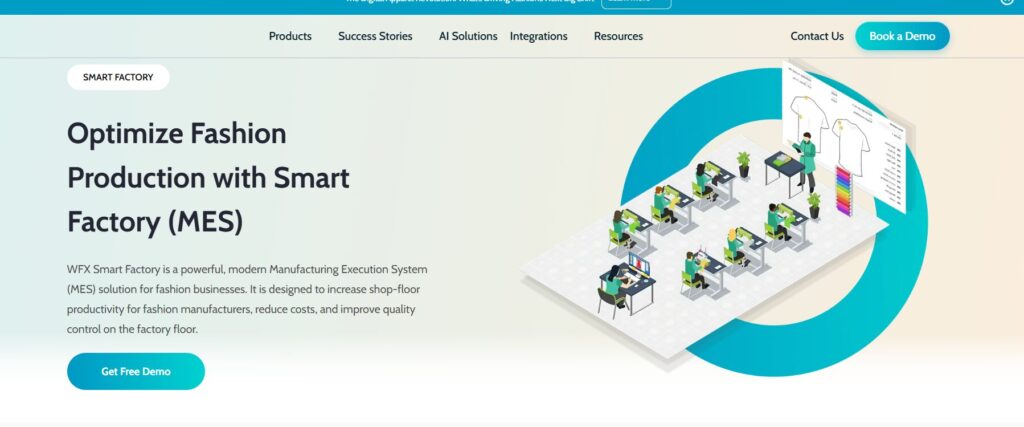
Website: worldfashionexchange.com/smart-factory.html
Best garment production tracking software for: Garment factories seeking an MES platform focused on digitizing floor-level production.
WFX Smart Factory is described as a system built to fully digitize floor production, using a central MES to plan, execute, track, and optimize each step of apparel production. Capabilities include generating bundle and box labels, uploading operation targets, tracking production order status, and monitoring factory performance and line efficiency through a mobile app and TV displays.
WFX Smart Factory is part of a broader suite that also includes apparel ERP and fashion PLM products, so manufacturers comparing garment production tracking software may want to evaluate how tightly the Smart Factory module integrates with the rest of the WFX platform if they need product development data connected to production.
5. Datatex CAMS
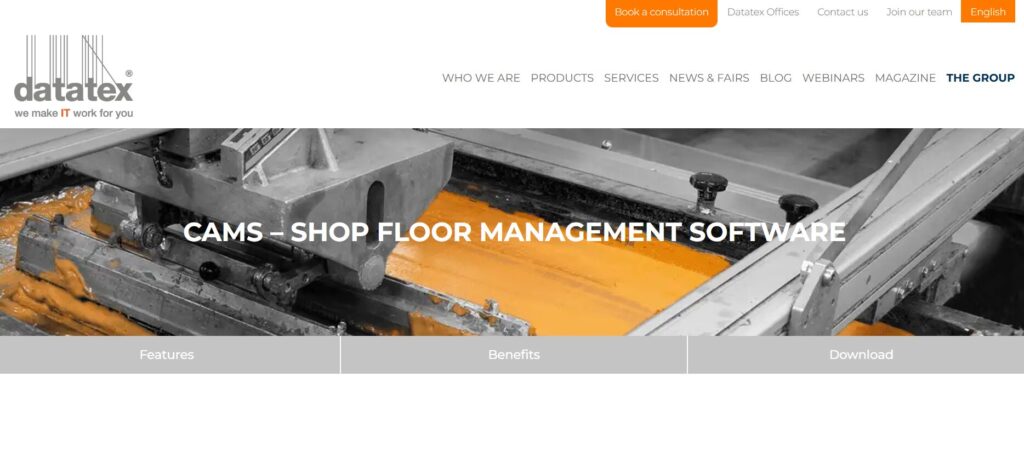
Website: datatex.com/portfolio-items/cams-erp-software-for-production-industry/
Best garment production tracking software for: Textile and garment manufacturers that need an MES connected with broader production and ERP information.
Datatex CAMS is designed to detect, record, and collect real-time production data directly from the shop floor, natively integrated with Datatex’s NOW ERP solution for textile and garment manufacturing.
The system connects machines, operators, and departments from raw material picking through finished goods shipment.
Datatex CAMS leans toward textile mills and vertically integrated garment operations that need machine-level data collection alongside operator and material tracking. Manufacturers without heavy machine automation on the floor may find some of its capabilities go beyond what a standard cut-and-sew operation needs.
6. ApparelMagic
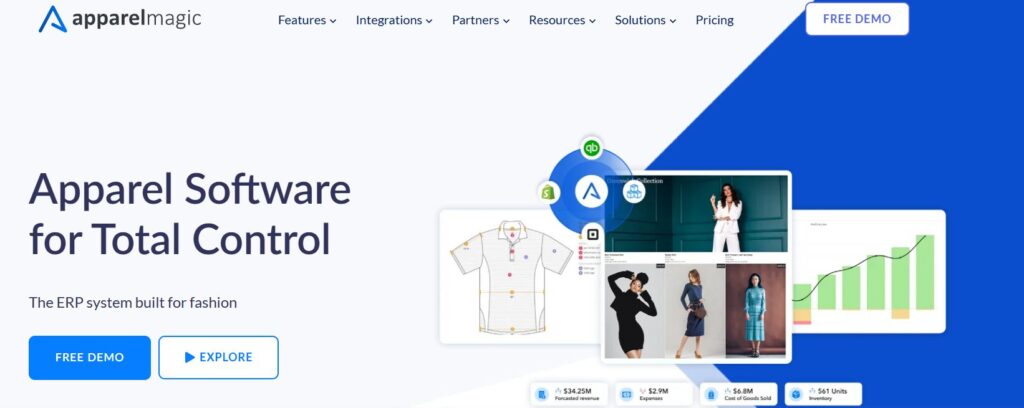
Website: apparelmagic.com/
Best garment production tracking software for: Apparel businesses that want WIP and production tracking within a broader apparel ERP and PLM system.
ApparelMagic offers comprehensive WIP tracking that controls purchasing and production through every stage, manages partial deliveries, and allows WIP to be viewed by project, style, vendor, and date.
Its multi-stage manufacturing functionality calculates sales demand and material requirements and issues vendor contracts including pull sheets, with automatic cost actualization for transparency.
ApparelMagic is often evaluated by smaller and mid-sized apparel brands that need production visibility within a broader ERP and PLM system rather than a dedicated shop floor execution tool.
Best Garment Production Tracking Software Comparison Table
Below is a closer look at some of the best garment production tracking software solutions compared side-by-side.
| System | Main Focus | Best Suited For |
| PolyPM | Connected ERP, PLM, materials, and production execution | Garment manufacturers wanting one connected system from style and BOM through manufacturing and shipment |
| BlueCherry Shop Floor Control | Dedicated shop floor control and analytics | Manufacturers requiring detailed real-time factory visibility |
| Aptean Apparel Shop Floor Control | Operator, labor, WIP, and quality control | Large or complex apparel manufacturing floors |
| WFX Smart Factory | Digital garment factory MES | Factories focused on operator, line, and floor-level execution |
| Datatex CAMS | Shop floor MES and production data collection | Textile and garment manufacturers needing machine, operator, and material data |
| ApparelMagic | WIP tracking within apparel ERP and PLM | Apparel businesses seeking broader production and operational management |
→ Do you need production data connected to product development, not just the shop floor? Contact PolyPM to see how style, BOM, and tech pack data flow directly into manufacturing orders.
Why Production Tracking Must Connect With Inventory
Garment production tracking software is incomplete when it cannot show which fabric rolls were used, whether dye lots match across a cut, what raw material remains, which bundles are currently in production, what subcontractors currently hold, and what is actually ready to ship.
A production manager who can see that an order is 80 percent complete still has an incomplete picture if they cannot confirm whether the remaining 20 percent has fabric allocated to it. Roll-level inventory visibility matters because two rolls from the same fabric order can sometimes carry slightly different dye lots, and shipping garments cut from mismatched lots creates costly quality claims from customers.
PolyPM ties inventory directly to cut planning, WIP, labor, and production scheduling through its Apparel Inventory Management Software. Because material consumption is recorded as bundles move through production, a manager can see exactly how much fabric was actually used against a style compared to what the original cut plan estimated, which helps identify waste or shortages before they affect the next order.
→ Do you know exactly which fabric rolls and dye lots are tied to your current production orders? Reach out to PolyPM to see how connected inventory and production tracking reduce shortages and mismatched dye lots.
Why Cut Tickets and Bundle Tracking Matter
Manufacturers need visibility before and after cutting, not just once garments reach the sewing floor. A cut ticket typically documents which fabric rolls and dye lots were used, which markers were applied, how many layers were cut, and what the actual fabric usage was compared to the plan.
Once cutting is complete, those cut pieces become bundles that move through sewing operations, embellishment, finishing, and quality control.
If a garment production tracking software system only starts tracking activity once bundles reach sewing, a manufacturer loses visibility into how efficiently the cutting room performed and whether fabric waste is trending in the wrong direction.
PolyPM connects cut ticket data with downstream bundle-level production tracking, so the fabric usage recorded at the cutting stage carries through to the bundles created from that cut. This is one of the areas where an apparel-specific system tends to outperform a generic MES, because cut planning and bundle generation are unique to sewn products manufacturing rather than general assembly manufacturing.
Manufacturers working with pattern design and marker optimization before cutting often pair production tracking with a dedicated pattern design system like PolyNest, which reduces fabric waste through marker efficiency before the cutting stage even begins.

When PolyPM May Be the Best Garment Production Tracking Software for You
PolyPM tends to be a strong fit for manufacturers that need the following.
- A manufacturing-specific ERP and PLM platform rather than a generic system adapted to apparel
- Product development and BOM data connected directly to production execution
- Roll and dye-lot visibility tied to cutting and consumption
- Cut ticket integration with downstream bundle tracking
- Bundle-level WIP visibility through sewing, embellishment, and finishing
- Barcode-based production tracking on the shop floor
- Subcontractor traceability for work sent outside the facility
- Actual material consumption recorded against planned usage
- Finished-goods visibility once production completes
- Packing and shipment preparation tied to customer orders
PolyPM is not automatically the best garment production tracking software for every manufacturer. A factory that only needs detailed labor and incentive pay tracking on a single sewing floor, without a need for connected PLM or inventory data, may be better served by a dedicated shop floor control system.
The best garment production tracking software depends on how much of the manufacturing lifecycle you want managed inside one platform, compared to how many separate systems you are willing to integrate and maintain.
→ Not sure whether a connected platform or a dedicated shop floor tool fits your operation better? Talk to PolyPM about your current systems and where the gaps are.
How to Choose the Best Garment Production Tracking Software
Evaluating garment production tracking software gets easier once you answer a few practical questions about your own operation.
Do you produce internally, outsource to subcontractors, or both? Manufacturers with a mix of internal production and outsourced work need subcontractor tracking built into the system, not bolted on as an afterthought.
How much unit or bundle level detail do you actually need? A small operation may only need production order status, while a larger facility with piece rate pay needs bundle or unit level tracking tied to individual operators.
How many facilities are involved? Multi-facility manufacturers need a system that consolidates data across locations rather than requiring separate reports from each site.
What are your subcontractor workflows? If embellishment, sewing, or finishing is regularly sent outside your facility, confirm the system can track materials and units while they are away from your floor.
Do you need barcode or RFID data collection? Manual data entry introduces delay and error, so most manufacturers moving away from spreadsheets prioritize barcode or mobile scanning.
How important is operator and labor tracking? Facilities with incentive pay or detailed labor cost reporting need stronger workforce visibility than facilities paid on a flat hourly basis.
What quality control workflow do you follow? Confirm whether the system tracks defects and quality holds at the operation level or only at the end of the line.
What ERP and PLM systems do you already use? If you already have a PLM or ERP system you want to keep, prioritize integration capability over an all-in-one platform that duplicates functionality you already have.
What does your cut floor look like? Manufacturers doing their own cutting and marker making should evaluate how well production tracking connects with cut planning and material usage.
What implementation and customization work is realistic for your team? A system that requires months of customization may not be practical for a smaller manufacturer, while a larger operation with complex workflows may need that flexibility.
Working through these questions before comparing vendors will narrow the list of garment production tracking software options faster than starting from a feature checklist alone.
Consider a mid-sized workwear manufacturer running three sewing lines in house and sending embroidery to two outside subcontractors. That manufacturer needs bundle-level WIP tracking on the floor, subcontractor visibility for the embroidery work, and a clear connection between the finished bundles coming back from embellishment and the packing schedule.
A dedicated shop floor control tool might handle the in-house sewing lines well, but it may not natively track units while they sit with a subcontractor. That gap is exactly where a connected system like PolyPM tends to close the distance between departments that would otherwise rely on phone calls and email updates to know where an order stands.
Now consider a denim manufacturer cutting its own fabric with several markers per style and multiple dye lots per order. That manufacturer needs cut ticket data tied directly to bundle generation so that fabric usage and dye lot assignment carry through to sewing.
A system that only starts tracking activity once bundles reach the sewing floor would miss the cutting room entirely, leaving a blind spot in exactly the stage where fabric waste and dye lot mismatches originate. These two examples show why the best garment production tracking software depends heavily on where your operation’s biggest visibility gaps actually sit, not on which vendor has the longest feature list.
Find the Best Garment Production Tracking Software
The best garment production tracking software depends on what your operation actually needs, whether that is dedicated shop floor control, detailed operator and labor tracking, a full MES for machine and line level data, straightforward WIP management, or a broader connected platform that ties materials, product development, production, and shipping together in one system.
PolyPM fits manufacturers who want production tracking connected to cutting, materials, subcontractors, and finished goods rather than managed as a standalone tool. If you are evaluating how a connected system could replace disconnected spreadsheets or separate point solutions, the PolyPM team can walk through your current production workflow and show where the gaps are.
Ready to see how PolyPM connects materials, cutting, bundles, subcontractors, finished goods, and shipment readiness in one platform? Contact PolyPM to schedule a walkthrough built around your production process.
Best Garment Production Tracking Software: FAQs
What is garment production tracking software?
Garment production tracking software gives manufacturers visibility into how garments move through cutting, sewing, embellishment, quality control, finishing, and packing. The best systems connect that activity with materials, styles, and customer orders rather than tracking status in isolation.
How is garment production tracking software different from a generic MES?
A generic manufacturing execution system is typically built for continuous or discrete manufacturing outside apparel, such as electronics or automotive parts. Garment production tracking software is built around bundle tickets, dye lots, sizes, colorways, and subcontracted sewing work that generic MES platforms do not account for.
Does PolyPM track production by unit or by bundle?
PolyPM supports tracking by unit, bundle, or complete production order, which gives manufacturers flexibility depending on how detailed their shop floor reporting needs to be.
Is PolyNest the same as PolyPM’s production tracking?
No. PolyNest handles pattern design, grading, marker making, and cutting preparation. PolyPM handles the manufacturing orders, WIP, materials, and production execution that occur once cutting is complete.
Why does production tracking need to connect with inventory?
Without inventory visibility, a manufacturer cannot confirm which fabric rolls or dye lots were used against an order, what material remains, or whether shortages are likely to delay a shipment. Connected systems reduce the risk of mismatched dye lots and material shortages discovered too late.
Can garment production tracking software handle subcontracted work?
Some systems handle subcontractor tracking better than others. Manufacturers that regularly send sewing, embellishment, or finishing work outside their facility should confirm that materials and units can be tracked while work is away from their floor, not just once it returns.
How do I know if I need a dedicated shop floor control system instead of a connected ERP and PLM platform?
If your primary need is detailed operator and labor tracking on a single sewing floor, a dedicated shop floor control system may be sufficient. If you want production data connected to product development, materials, and shipping, a connected platform like PolyPM is usually a better fit.
What should I look for when comparing the best garment production tracking software vendors?
Prioritize apparel-specific functionality, the level of unit or bundle detail you need, barcode or mobile data collection, subcontractor tracking, integration with your existing ERP or PLM systems, and how well the system connects cutting, materials, and production execution rather than treating each as a separate silo.