Jewelry manufacturing is not simple inventory management. A single style might involve a dozen components, several metals, multiple stone types, and a handful of finishing steps before it ever reaches a customer. When materials, production, and orders live in separate spreadsheets or disconnected tools, small errors turn into missed deadlines and shrinking margins fast. A jewelry ERP for manufacturers built to handle this complexity changes that equation.
PolyPM gives jewelry manufacturers one connected system for materials, components, styles, variants, production, costing, and orders, replacing the patchwork of tools that slow growing manufacturers down.
Why Jewelry Manufacturing is Difficult to Manage With Disconnected Systems
Most businesses did not start out needing a jewelry ERP for manufacturers. A spreadsheet for stone inventory, another for metal weights, a separate system for sales orders, and a production log on a whiteboard can work for a while. But as order volume grows and styles multiply, that patchwork starts to break down.
Manual costing becomes a guessing game once labor, subcontractor charges, and material waste all need to be factored in separately. Purchasing teams place orders without knowing exactly what is already sitting in the vault or on the shop floor. Production managers find out about a shortage of clasps or findings only after a job is already behind schedule. Order tracking lives in email threads and paper tickets rather than a single source of truth.
This is where PolyPM changes the picture. Instead of stitching together five or six disconnected tools, PolyPM gives jewelry manufacturers one system of record for every stage of the business, from raw materials through finished goods and shipped orders. Using PolyPM as a jewelry ERP for manufacturers means you don’t react to problems after they happen. You work from real-time data that shows exactly where every material, job, and order stands.
→ Are disconnected spreadsheets and manual tracking slowing down your jewelry production? Talk to the PolyPM team about a jewelry ERP for manufacturers who need one connected system.
What PolyPM Manages as a Jewelry ERP for Manufacturers
A jewelry ERP for manufacturers has to go far beyond basic stock counts. PolyPM was built to manage every moving part of jewelry production inside a single platform, so manufacturers are not toggling between systems to get a complete picture of the business.
Raw Materials and Components
When used as a jewelry ERP for manufacturers, PolyPM tracks raw materials down to the component level. Each material can carry its own attributes, so nothing gets flattened into a generic “inventory item” that hides the details production teams actually need.
Style, SKU, and Variant Management
Every jewelry style typically exists in multiple metal options, stone combinations, sizes, and finishes. PolyPM manages style and SKU data alongside these variants, so a single master style can branch into dozens of sellable configurations without manufacturers rebuilding records from scratch for each one.
Bills of Materials
PolyPM’s Bill of Materials functionality lets manufacturers define exactly which materials and components go into each style and variant, including quantities, weights, and costs. When a style changes, whether that is a stone substitution or a plating upgrade, the BOM updates and every downstream cost calculation follows automatically.
Production Orders and Workflow
Production orders in PolyPM move through defined stages, whether that is casting, stone setting, polishing, plating, or quality control. Manufacturers can see exactly which jobs are in progress, which are delayed, and where bottlenecks are forming, all from the same system used for materials and costing.
Inventory and Finished Goods
When used as a jewelry ERP for manufacturers, PolyPM connects raw material inventory, work in progress, and finished goods inventory in one view. Manufacturers always know what is available to sell, what is tied up in production, and what needs to be reordered.
Costing and Customer Orders
Because materials, BOMs, and production all live in PolyPM, costing calculations and customer order fulfillment draw from the same accurate, real-time data rather than estimates pulled together after the fact.
Supplier and Vendor Management
Jewelry manufacturers typically source from multiple metal refiners, stone dealers, and findings suppliers, often with different lead times and pricing structures. PolyPM keeps vendor records, pricing history, and purchase order activity in the same system used for materials and production, so purchasing decisions are based on current supplier performance rather than outdated notes or separate vendor spreadsheets.
Taken together, these capabilities mean a manufacturer does not need a separate tool for materials, a separate tool for production scheduling, and a separate tool for order management. PolyPM was designed so that jewelry manufacturers can run the entire operation, from a raw stone or metal purchase through a shipped custom order, inside one platform.
→ Struggling to manage materials, styles, and production orders across separate tools? Contact PolyPM to see how one system can handle it all.

Why Material and Component Tracking Matters in Jewelry Production
Jewelry production runs on small parts. A missing box of clasps or an inaccurate stone count can stall an entire production run, even when the metal and the majority of components are ready to go. Manufacturers who rely on manual counts or outdated spreadsheets often do not discover a shortage until a job hits the production floor, and by then it is too late to avoid a delay. This is where having the right jewelry ERP for manufacturers makes a major difference.
PolyPM addresses this by giving manufacturers real-time visibility into every material and component, not just finished goods. When a production order is created, PolyPM checks material availability against the Bill of Materials automatically, flagging shortages before a job is scheduled rather than after it stalls. Purchasing teams working from PolyPM see accurate, current data instead of guessing based on the last physical count.
This level of accuracy matters even more for manufacturers working with precious metals and stones, where the cost of a shortage is not just a delay but tied-up capital sitting in unfinished goods. PolyPM’s component-level tracking gives manufacturers the confidence that a production schedule reflects what is actually available, not what a spreadsheet said a month ago.
→ Are missing components causing delays you cannot see coming? Reach out to PolyPM to see how the platform can be applied as a jewelry ERP for manufacturers.
How PolyPM Helps With Costing and Margins
Costing a piece of jewelry accurately requires pulling together material costs, labor, subcontractor charges, custom work, and material waste, then applying all of it against the final selling price. When this process happens manually, across multiple spreadsheets, margins are often based on estimates rather than actual numbers.
PolyPM builds costing directly into the Bill of Materials and production workflow, so every style and variant carries an accurate, current cost as materials, labor rates, or subcontractor charges change. Manufacturers using PolyPM can see margin by style, by collection, or by customer order, rather than waiting until month-end to find out whether a run was profitable.
Waste and scrap are a real cost in jewelry manufacturing, particularly with precious metals, and PolyPM, as a jewelry ERP for manufacturers, accounts for this in costing calculations rather than treating it as an afterthought. Custom work and one-off orders, which are common in jewelry manufacturing, can be costed the same way as standard production runs, so manufacturers are not pricing custom jobs based on rough estimates.
This visibility gives manufacturing leaders the ability to catch a thin margin before a job ships, not after. PolyPM turns costing from a backward-looking exercise into a tool manufacturers can use while a job is still in progress.
→ Do you know your true margin on every style, collection, and custom order? Talk to PolyPM about costing built for jewelry manufacturers.
Managing Custom Orders and Product Variations in a Jewelry ERP for Manufacturers
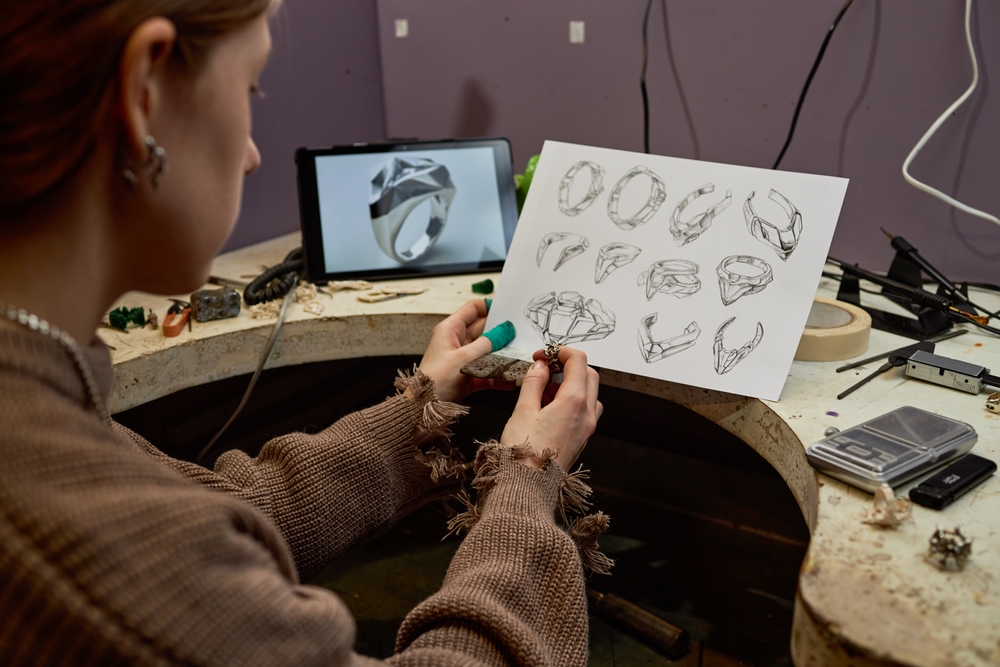
Custom work is a normal part of jewelry manufacturing, whether that is a resized ring, a specific stone substitution, a custom engraving, or an entirely bespoke piece for a private client. Manufacturers also deal with standard variation across collections, including different metals, finishes, sizes, and stone combinations for the same base style.
Handling this in spreadsheets or disconnected systems usually means recreating records manually for every variation, which slows down order entry and increases the risk of an error making it into production. PolyPM manages variants directly within the style and SKU structure, so a manufacturer can configure a custom order, whether that is a size change, a metal substitution, or a specific engraving, without rebuilding the underlying style from scratch.
Because PolyPM connects variant configuration to the Bill of Materials and costing engine, a custom order automatically pulls the correct materials, calculates the correct cost, and generates the correct production order, all without manual recalculation. This matters for manufacturers producing both standardized collections and one-off custom pieces side by side, since PolyPM treats both within the same connected workflow rather than requiring separate processes.
Manufacturers working with retail partners, private clients, or wholesale accounts that all request variations on the same base styles benefit from this consistency. PolyPM keeps custom and standard production running through the same system, so nothing falls through the cracks between a client request and a finished piece.
→ Do custom orders and product variations slow down your production process? Connect with PolyPM about managing variants without the manual rework.
Why Jewelry Manufacturers Need Production and Inventory Connected
Production, purchasing, inventory, and order fulfillment cannot function well as separate systems in jewelry manufacturing. When a production order is created without visibility into current inventory, purchasing ends up reacting to shortages instead of planning ahead. When order fulfillment runs from a different system than production, customers get inaccurate delivery estimates.
When used as a jewelry ERP for manufacturers, PolyPM connects these functions so they draw from the same data. A production order checks against the current material inventory. A purchase order reflects what is actually needed based on open production and sales orders, not a rough estimate. Order fulfillment reflects the real status of a job, whether that is in the casting stage, with the stone setter, or ready to ship.
This connection is what allows jewelry manufacturers to scale without adding administrative overhead. Instead of hiring more staff to reconcile numbers between systems, manufacturers using PolyPM rely on the platform itself to keep production, inventory, and orders aligned. Manufacturing leaders get a single, accurate view of the business instead of five partial views that need to be manually cross-checked.
This matters just as much for smaller production runs as it does for high-volume manufacturing. A manufacturer producing a limited run of a new collection needs the same accurate connection between materials, production, and orders as one running thousands of units a month. PolyPM applies the same connected structure regardless of order size, so manufacturers are not maintaining a separate, simplified process for smaller jobs and a more rigorous one for larger production runs.
→ Are your production, inventory, and order systems working from different numbers? Contact PolyPM about a connected jewelry ERP for manufacturers.
Choosing PolyPM as Your Jewelry ERP for Manufacturers
Manufacturers evaluating a jewelry ERP for manufacturers are usually looking for a specific set of capabilities, and PolyPM was built around exactly this list.
Core Capabilities to Look For
Manufacturing-specific workflows matter more than generic business software, since jewelry production does not follow the same steps as apparel, electronics, or food manufacturing. PolyPM’s production workflows are configurable to match casting, stone setting, polishing, plating, and quality control stages specific to jewelry manufacturing.
Material tracking down to the component level is non-negotiable for jewelry manufacturers working with metals, stones, and findings, and PolyPM tracks each of these with the attributes that matter, rather than treating every material as a generic stock item.
Bill of Materials management inside PolyPM ties directly into costing and production, so manufacturers are not maintaining BOMs in a separate spreadsheet disconnected from the rest of the business.
Inventory visibility across raw materials, work in progress, and finished goods gives manufacturers a real-time view rather than a periodic snapshot.
Costing built into the production workflow means manufacturers know margin by style, collection, and order without a separate, manual costing exercise.
Production order management connects directly to materials and inventory, so shortages are flagged before they cause delays.
Purchasing inside PolyPM reflects actual production and sales demand, rather than manual reordering based on gut feel.
Order fulfillment draws from the same real-time data as production and inventory, so customer commitments reflect what is actually happening on the shop floor.
Reporting across all of these functions gives manufacturing leadership the ability to see trends in costing, production efficiency, and inventory accuracy without pulling data from five different places.
Why Purpose-Built Beats Generic
Manufacturers comparing options for a jewelry ERP for manufacturers should look for a platform built specifically around these workflows rather than a generic ERP adapted after the fact. PolyPM’s approach is to give jewelry manufacturers the same purpose-built depth that specialized manufacturers in other industries have relied on for years.
Many manufacturers evaluating a jewelry ERP for manufacturers have already tried a generic accounting package, a retail-focused point of sale system, or a spreadsheet-based process that no longer holds up under current order volume. The common thread in these situations is a system that was never designed around jewelry production in the first place. PolyPM was built with manufacturing workflows as the starting point, not an add-on module bolted onto retail or accounting software, which is why manufacturing teams find the day-to-day workflow feels closer to how their production floor actually operates.
Implementation and Ongoing Support
Implementation timelines and ongoing support also matter when evaluating a jewelry ERP for manufacturers. A platform that takes a year to configure or requires constant outside consulting adds cost and delay before a manufacturer sees any benefit. PolyPM’s implementation approach focuses on getting materials, BOMs, and production workflows configured around how a manufacturer already runs the business, so the system supports existing production knowledge rather than forcing a manufacturer to rebuild processes from scratch.
→ Ready to compare your current systems against a jewelry ERP built specifically for manufacturers? Talk to PolyPM about what a demonstration can show you.
Why Choose PolyPM Jewelry ERP for Manufacturers
Growth exposes the limits of manual processes faster than almost anything else in jewelry manufacturing. A system that worked fine for a handful of production runs a month starts to strain once order volume, style count, and customer accounts all increase at the same time.
PolyPM gives growing jewelry manufacturers a foundation that scales with the business rather than becoming a bottleneck. Adding new styles, variants, or product lines does not require rebuilding processes from scratch, since PolyPM’s style, BOM, and costing structure is designed to expand alongside a growing catalog. New production stages or subcontractor relationships can be added to existing workflows without disrupting jobs already in progress.
Manufacturing leadership gains the visibility needed to make decisions with confidence, whether that is entering a new market, taking on a larger wholesale account, or expanding into new metal and stone categories. Instead of manual processes that require more staff time as volume grows, PolyPM’s connected system keeps overhead manageable even as the business scales.
Replacing manual processes with PolyPM is not just about efficiency today. It is about giving jewelry manufacturers the operational foundation to take on more business without the growing pains that come from outdated systems trying to keep up with a growing company.
Manufacturers that reach a certain size often find themselves managing multiple locations, whether that is a separate design studio, a production facility, and a distribution point. PolyPM’s structure supports this kind of multi-location operation, keeping materials, production status, and inventory synchronized across every part of the business rather than requiring manual reconciliation between locations at the end of each week.
For manufacturing leadership evaluating long-term technology investments, the question is rarely whether growth will create new demands on the business. It is whether the systems in place today can support that growth without a disruptive replacement project two or three years down the road. A jewelry ERP for manufacturers that is built to scale from the start, like PolyPM, removes that risk from the equation.
→ Looking for a jewelry ERP for manufacturers that connects materials, production, inventory, and orders as you grow? Contact PolyPM to schedule a conversation about your operations.
Final Thoughts
Jewelry manufacturing involves far more than tracking stock. Materials, components, styles, variants, production stages, costing, and customer orders all need to work from the same accurate data to keep a business running smoothly and profitably. PolyPM gives jewelry manufacturers a single connected system built around these exact requirements, replacing the spreadsheets and disconnected tools that slow growth and hide margin problems. Manufacturers ready to move beyond manual processes and gain real visibility into their operations can see what a purpose-built jewelry ERP for manufacturers looks like in practice with PolyPM.
→ Ready to see how PolyPM can connect your materials, production, inventory, and orders? Talk to the PolyPM team today.
Jewelry ERP for Manufacturers: FAQs
What makes a jewelry ERP for manufacturers different from a general ERP system?
A jewelry ERP for manufacturers, like PolyPM, is built around the specific realities of jewelry production, including metal and stone tracking, variant-heavy styles, and custom order workflows. General ERP systems typically require heavy customization to handle these details, while PolyPM manages them natively.
Can PolyPM manage both standard collections and custom jewelry orders?
Yes. PolyPM handles custom orders and standard production runs within the same connected workflow, so manufacturers do not need separate systems or manual processes for one-off client requests versus catalog styles.
How does PolyPM help with jewelry costing and margin visibility?
PolyPM ties costing directly to the Bill of Materials and production workflow, factoring in material costs, labor, subcontractor charges, and waste, so manufacturers can see accurate margin by style, collection, or order rather than relying on manual, after-the-fact calculations.
Does PolyPM track components like stones, metals, and findings separately?
Yes. PolyPM tracks materials at the component level, capturing attributes specific to each type, whether that is metal weight, stone characteristics, or finding details, rather than treating every material as a generic inventory item.
How does PolyPM prevent production delays caused by material shortages?
PolyPM checks material availability against the Bill of Materials when production orders are created, flagging shortages before a job is scheduled rather than after it stalls on the shop floor.
Is PolyPM suitable for jewelry manufacturers handling multiple product variants?
Yes. PolyPM manages style, SKU, and variant data together, so a single master style can expand into multiple metal, stone, size, and finish combinations without manufacturers manually recreating records for each version.
How does PolyPM connect production, inventory, and purchasing for jewelry manufacturers?
PolyPM keeps these functions working from the same real-time data, so purchasing reflects actual production and sales demand, production checks against current inventory, and order fulfillment reflects the true status of each job.
How does PolyPM support jewelry manufacturers as they grow?
PolyPM’s style, BOM, costing, and production structure is designed to scale with a growing catalog and order volume, giving manufacturers the operational foundation to take on more business without adding administrative overhead.