Fabric nobody can find is still fabric you paid for. Most apparel manufacturers learn that in the middle of a cut plan. Manufacturing inventory management software exists to prevent that moment, yet plenty of factories still run on spreadsheets, a whiteboard, and the memory of one person in the warehouse.
Apparel inventory does not behave like inventory in other industries. A roll is not a unit. A style is not a sellable item until a size and a color are attached to it. Trims arrive in cartons, get issued in dozens, and get counted in pieces. Generic systems flatten all of that into a single stock number and lose the detail that drives cutting, sewing, and shipping.
We built our apparel inventory management software around those realities instead of asking manufacturers to work around them. PolyPM tracks raw materials at roll level, holds shade and lot detail, reserves stock against live orders, and shows work in progress as it moves across the floor.
PolyPM has been refined for apparel manufacturers for more than two decades, and PolyNest, our pattern design system, has served the industry since 1986. No add-ons. No industry layer bolted onto a general-purpose platform.
→ Are you making cut decisions based on stock numbers you do not fully trust? Talk to the PolyPM team about what accurate inventory visibility looks like inside an apparel plant.
Why Apparel Inventory Breaks Down Long Before the First Cut
Inventory problems rarely announce themselves. They build up across dozens of small gaps between purchasing, receiving, cutting, sewing, and shipping, and they only become visible when a shipment misses its date or a physical count comes back thousands of yards short.
Purchasing buys in one language, the cutting room works in another
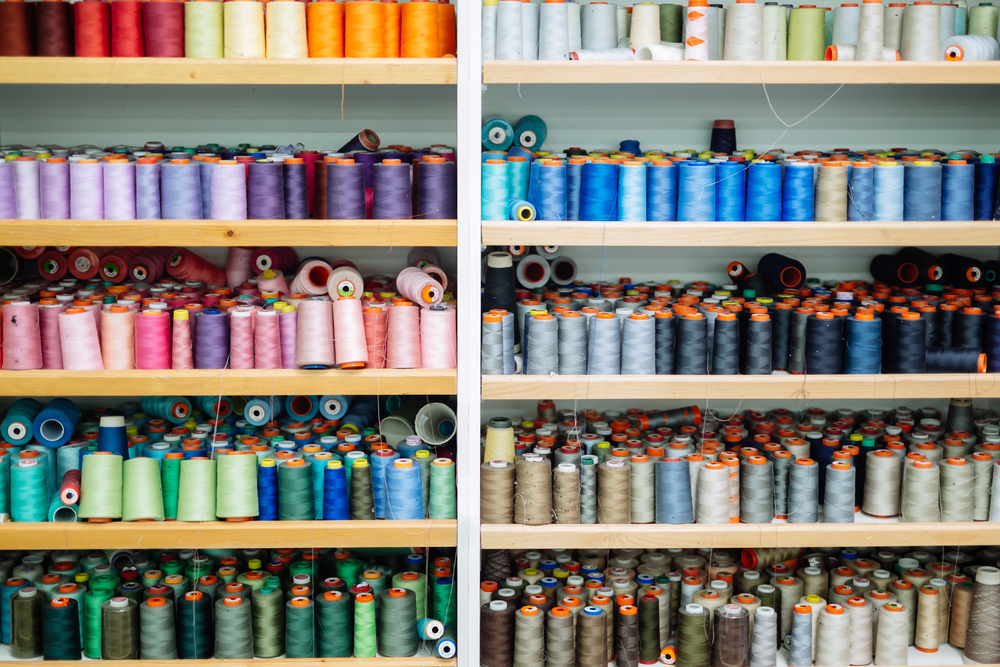
A purchase order says 4,000 yards of a jersey knit. Receiving logs 4,000 yards. The cutting room, meanwhile, needs to know how those yards are split across rolls, which rolls share a dye lot, how much usable width each one has, and which rolls were already pulled for a sample run last week.
When the system only holds the total, the cut planner walks the warehouse to find out. That walk is the hidden cost of a stock record that was never built for fabric.
Trims and findings get counted last and cause the most delays
Fabric gets attention because it is expensive. Zippers, labels, elastic, drawcords, and care tickets get attention when a sewing line stops. Shortages on low-value items hold up high-value orders constantly, usually because consumption was estimated from a style average rather than calculated from an accurate bill of materials.
Work in progress is the biggest blind spot of all
Once goods leave the cutting table, most factories lose precision. Bundles sit at an operation, go to a contractor for embroidery, come back, and get counted again at packing. Anything that happens between those points lives in a supervisor’s head or on a clipboard. Without bundle-level tracking, nobody can say how many units are genuinely in progress, where they are, or which orders are at risk.
The numbers get worse every time they are copied
Every manual re-entry between systems adds error. A spreadsheet updated weekly is wrong daily. By the end of a season, the gap between book inventory and physical inventory is large enough that finance writes it off and operations stops trusting the report entirely.
→ Is your team still walking the warehouse to confirm what the system already claims to know? Ask PolyPM how roll-level tracking removes that step.
What Manufacturing Inventory Management Software Has to Do Inside an Apparel Plant
Stock control in apparel is not a warehouse task. It touches product development, purchasing, cutting, sewing, decoration, and shipping, and the system has to hold all of those views at once.
In practice, that means a few specific jobs:
Track materials at the level they physically exist. Rolls, lots, shades, widths, and put-away locations, not just a yardage total. The same applies to piece goods, trims, packaging, and labels.
Calculate requirements from the actual bill of materials. Every style, color, and size combination consumes different amounts. Material requirements planning has to work from real consumption data, net of what is already on hand or on order.
Reserve stock against live demand. An order that has been confirmed should hold the materials it needs, so the same roll is not promised to two cut tickets.
Follow goods through production. Cut tickets, bundles, operations, contractor shipments, and returns all change where inventory sits and what it is worth.
Keep finished goods accurate by size and color. Allocation, pick, pack, and ship all depend on it.
Cost the result honestly. Materials, labor, decoration, and subcontract charges belong on the order they were consumed by.
A warehouse app handles the first item on that list. A general ERP handles the last two reasonably well and struggles with everything in the middle. Apparel manufacturers need all of it in one place, which is why apparel management software built for the industry tends to outperform a general platform that has been configured to approximate it.
→ How many of those six jobs does your current system actually do without a workaround? Book a walkthrough with PolyPM and compare it against your process.
How PolyPM Solves It With Manufacturing Inventory Management Software
Our approach to manufacturing inventory management software starts from the bill of materials and follows the goods, rather than starting from a warehouse record and hoping production reports back accurately. Here is how that works in sequence.
1. Materials are defined once, during product development. When a style is created in PolyPM, its bill of materials carries every fabric, trim, label, and packaging item, with consumption by size and colorway. Nothing has to be re-keyed later. Purchasing, costing, and planning all read from the same record.
2. Requirements are netted against what you already hold. PolyPM compares demand from confirmed and forecast orders against on-hand stock, open purchase orders, and allocated material. The output is a buy list with quantities and dates, not a yardage estimate that still needs a second opinion.
3. Receipts are captured at roll and lot level. Each roll gets its own identity, with supplier, lot, shade, width, length, and location. Shade sorting stops being a manual exercise. When a dye lot runs short, you can see exactly which open orders depend on it.
4. Stock is reserved against the order that needs it. Allocation happens against specific orders and cut tickets, so a roll committed to one customer does not get pulled into another job on Friday afternoon.
5. Issues are recorded as material leaves the warehouse. Fabric issued to a cut ticket moves out of raw material and into work in progress at the moment it is issued. Trims issued to the sewing floor do the same. Inventory reflects the factory, not last week’s count.
6. Bundles carry the goods through production. PolyPM tracks bundles through operations, subcontractors, and decoration processes such as screen printing, embroidery, and sublimation. Units that leave for an outside service are still visible, still valued, and still attached to the order they belong to.
7. Finished goods, costing, and shipping close the loop. Completed units post to finished goods by size and color, actual consumption posts back against the standard, and variances show up while you can still act on them.
The result is one record that purchasing, planning, the cutting room, the sewing floor, and finance all read from. When an operations manager asks how much of a fabric is genuinely available, the answer comes from the system rather than a walk through the aisles.
→ Would your production meetings get shorter if everyone opened the same live numbers? Schedule a PolyPM demonstration using your own styles and materials.

What Makes PolyPM Different From Generic Manufacturing Inventory Management Software
Almost every ERP vendor can show you a stock screen. The difference shows up in the details apparel manufacturers care about.
Apparel data structures are native, not configured. Size and color matrices, colorways, cut tickets, bundles, roll inventory, and marker yields exist in PolyPM as standard objects. On a general platform such as NetSuite, Odoo, Microsoft Dynamics GP, Acumatica, or Oracle Cloud ERP, the same concepts usually arrive through custom fields, third-party modules, or a partner’s apparel template. Each of those layers is something to maintain, test, and pay for again at the next upgrade.
PLM and ERP are one system. Our fashion apparel PLM software shares a database with production and inventory. A change to a bill of materials during development updates material requirements immediately. Most competing setups connect a separate PLM to a separate ERP and accept a sync delay, plus the reconciliation work that comes with it.
The costing model matches how apparel is actually made. Fabric by yield, trims by consumption, labor by operation, decoration by process, subcontract by service. Generic costing assumes a simpler assembly and gets the margin wrong on exactly the styles you need to price well.
Implementation does not start from scratch. Because the apparel logic is already in the product, projects focus on your workflows rather than on building apparel behavior from parts. That has a direct effect on the total cost of the software, both at go-live and over the following years.
We know the industry, not just the software. Our team has spent decades inside cut-and-sew operations. Conversations about shade blocking, marker efficiency, or contractor WIP do not need translating first.
→ Comparing platforms right now and unsure which differences matter? Bring your shortlist to PolyPM and we will go through it with you.
How PolyPM Connects Inventory to Purchasing, Production, and Product Development
Accurate stock figures are only useful if the rest of the business can act on them. In PolyPM, inventory sits in the middle of four workflows that most factories run separately.
Product development feeds it. Tech packs, measurements, colorways, lab dips, and the bill of materials are created once and become the basis for every material calculation downstream. When a designer swaps a zipper, purchasing sees the change the same day.
Purchasing acts on it. Material requirements planning produces supplier-ready purchase orders with quantities, lead times, and delivery dates. Vendor performance stays attached to the record, so repeated late deliveries become visible instead of anecdotal.
Production consumes it. Cut plans draw from reserved rolls. Production scheduling uses real material availability rather than an assumption, which is the difference between a schedule that holds and one that gets rebuilt every Monday. Our apparel production software systems track each cut ticket and bundle through to packing.
Finance values it. Work in progress, raw materials, and finished goods are valued continuously, so month-end becomes a review rather than an investigation.
This is also where broader apparel manufacturing ERP functionality earns its place. Order management, shipping, and financials read from the same inventory records, so a customer service rep quoting a ship date is working from the same data as the plant manager.
→ Does a change in product development still take days to reach your purchasing team? Ask us how PolyPM keeps those two groups on one record.
How PolyNest Reduces Consumption Before Inventory Ever Moves
The cheapest yard of fabric is the one you never had to buy. Inventory accuracy tells you what you have; marker efficiency decides how far it goes.
PolyNest handles pattern design, grading, and marker making, and it has been doing that work for apparel companies since 1986. Patterns can be created directly or imported through DXF, graded across the full size range, and nested into markers that make better use of every width and lay. Output drives automatic cutters and plotters without a manual re-draw.
A one percent gain in marker efficiency on a high-volume program is money that never leaves the business. For manufacturers running the same core styles season after season, that compounds.
Because PolyNest and PolyPM share the same product data, marker yields feed straight into costing and material planning. Your buy quantity reflects how the goods will actually be cut rather than a standard allowance, which is where a lot of excess fabric originates. Teams reviewing pattern design software alongside their inventory system usually find that the two decisions belong together.
→ Are you buying extra fabric to cover markers you have not optimized? Ask PolyPM about PolyNest and what better nesting would be worth on your top styles.
How to Evaluate Manufacturing Inventory Management Software Without Guessing
Most evaluations go wrong the same way. The demo uses the vendor’s sample data, every screen looks capable, and the gaps only appear six months into implementation.
A better test is to bring your own worst-case style to the demo. Pick something with multiple colorways, a wide size range, decorated panels, and at least one outside contractor. Then watch how the system handles it.
Questions worth asking any vendor:
- Can it track a specific roll from receipt to cut ticket without a custom field?
- Does the bill of materials calculate consumption by size and color, or only by style average?
- What happens to inventory value when bundles are at a subcontractor?
- Can a planner see available-to-promise material for an order before confirming a ship date?
- Does marker yield feed costing, or is yield entered by hand?
- How much of the apparel behavior is standard, and how much is a configuration your team will own forever?
We encourage manufacturers to run that list against us as well. Comparing which features genuinely improve apparel efficiency tends to narrow a shortlist faster than a feature matrix does. Our demonstrations use your styles, your materials, and your order patterns, because a sample dataset proves very little about your factory.
→ Want to see those six questions answered live on your own product data? Set up a working session with PolyPM.
Industries We Serve With Manufacturing Inventory Management Software
Inventory behaves differently depending on what you make, so our implementations reflect the vertical rather than applying one template everywhere.
Apparel manufacturing. Cut-and-sew operations running multiple seasons, size and color matrices, and mixed in-house and contract production.
Textile manufacturing. Mills and converters dealing with greige goods, dye lots, shade bands, and roll yardage that changes through finishing. Managing textile inventory accurately depends on holding lot and shade detail that a general system discards.
Garment manufacturing. High-volume production where bundle tracking and WIP accuracy determine whether delivery dates hold.
Uniform manufacturing. Contract programs with repeat orders, size runs, name and logo personalization, and long-term stock commitments.
Workwear manufacturing. Durable goods with heavy trims, specialized fabrics, and demanding customer specifications.
Safetywear manufacturing. Compliance-driven production where material certification and traceability back to a lot are mandatory, not optional.
Fashion manufacturing. Short cycles, frequent style changes, and sampling activity that consumes material outside the main production plan.
→ Does your current system understand how your vertical actually counts stock? Tell PolyPM what you manufacture and we will show you the closest match from our work.
Locations We Serve With Manufacturing Inventory Management Software
We work with manufacturers across the United States, Canada, and Latin America, from our headquarters in Baltimore, Maryland.
That footprint matters for inventory in particular. A brand cutting in Los Angeles and sewing in Guatemala needs one set of stock figures covering both, including material in transit and units sitting at a contractor across a border. PolyPM supports multi-facility and multi-country operations, so inventory stays consolidated even when production is not.
Discovery calls, demonstrations, and ongoing support are available in English and Spanish, which keeps plant supervisors and warehouse teams in the conversation rather than relying on a head-office translation of what the system does.
→ Running production in more than one country and reconciling stock by spreadsheet? Talk to PolyPM about consolidating it into one view.
Other PolyPM Services
Inventory is one part of what we do. The rest of the platform is built on the same data, which is why manufacturers usually adopt more of it over time.
Apparel manufacturing ERP. Order management, purchasing, costing, shipping, vendor management, and financials in one place.
Apparel manufacturing PLM. Style and line planning, tech packs, colorways, measurements, lab dips, sample management, and artwork, all feeding production directly.
Inventory and materials management. Roll-level raw materials, trims, warehouse control, reconciliation, shortage alerts, and finished goods.
Production and order management. Cut planning, bundle tracking, shop floor control, subcontractors, decoration, and shipment management. Order flow from entry to delivery is covered in our apparel order management functionality.
PolyNest pattern design. Pattern creation, grading, marker making, cutter and plotter integration, and fabric utilization.
→ Would replacing two or three disconnected systems simplify your week? Ask PolyPM which parts of the platform fit your operation first.
Choosing PolyPM for Manufacturing Inventory Management Software
Apparel manufacturers lose margin in the space between what the system says and what sits on the shelf. Closing that gap takes manufacturing inventory management software that understands rolls, lots, shades, bundles, size and color matrices, and contractor WIP as standard behavior.
PolyPM holds product development, purchasing, inventory, production, and costing on one record, and PolyNest reduces how much material you need in the first place. Built for apparel, refined over decades, with no add-ons required to make it fit your factory.
→ Ready to stop reconciling fabric counts by hand? Book a PolyPM demonstration and we will walk through your own styles, materials, and orders.
→ Follow us on LinkedIn for practical updates on apparel manufacturing, inventory control, and production technology.
Manufacturing Inventory Management Software: FAQs
How does PolyPM track fabric at roll level?
Every roll received into PolyPM carries its own identity: supplier, lot, shade, width, length, and warehouse location. When material is issued to a cut ticket, the specific rolls come out of stock and the remainder stays available with its detail intact. That lets your cutting room block shades correctly and lets planning see which open orders depend on a lot that is running short.
Can PolyPM handle inventory across several factories and countries?
Yes. We support multi-facility and multi-country operations, which is common among our customers cutting in the US and sewing in Mexico or Central America. Stock in each location, material in transit, and units held at contractors all appear in one consolidated view rather than in separate spreadsheets that someone reconciles at month end.
How does PolyPM keep work in progress accurate?
PolyPM tracks bundles through operations, subcontractors, and decoration processes including screen printing, embroidery, and sublimation. As bundles move, inventory and valuation move with them. A production manager can see how many units sit at each stage and which orders are exposed, without waiting for a floor count.
Does PolyPM replace a separate PLM system?
For most apparel manufacturers, yes. Product lifecycle management is part of PolyPM rather than a connected second system, so styles, tech packs, colorways, measurements, lab dips, and bills of materials live in the same database as purchasing and production. Development changes reach material planning immediately instead of waiting for a sync.
How is PolyPM different from configuring a general ERP for apparel?
General platforms reach apparel behavior through custom fields, add-on modules, or a partner template, and your team owns that layer permanently. PolyPM ships with size and color matrices, roll inventory, cut tickets, bundles, and apparel costing as standard. Implementation then focuses on your workflows rather than on recreating industry logic.
What does a PolyPM implementation involve?
We start with your data: styles, materials, suppliers, and open orders. Configuration follows your actual production flow, and training is delivered to the people who will use each part of the system, in English or Spanish. Most manufacturers phase it, often starting with inventory and purchasing before extending into full production control.
Does PolyPM work for smaller apparel manufacturers?
It does. Factories with a few dozen employees run PolyPM alongside operations with several plants. The deciding factor is usually complexity rather than headcount. If you manage styles across sizes and colors, buy fabric by the roll, and use contractors, the inventory problems are the same at any scale.
How does PolyPM connect to PolyNest for pattern and marker work?
PolyNest shares product data with PolyPM, so marker yields calculated during pattern work feed costing and material requirements directly. Your purchase quantities reflect how goods will actually be cut, and pattern revisions do not require anyone to re-enter consumption figures into a separate system.