
Across the major industry production sites like Los Angeles, New York, Miami, Chicago, Houston, and Greenville, and nearshore regions such as Guatemala City, San Pedro Sula, Tegucigalpa, San Salvador, and Managua, manufacturers are dealing with rapid style changes, high variation, complex supply chains, and cross-border coordination challenges. Separate PLM and ERP systems cannot keep up with current demands. Modern workflows require apparel manufacturing ERP software that brings design, costing, sourcing, planning, cutting, sewing, embellishment, and WIP tracking into one unified system.
→ Learn how PolyPM ERP creates real-time visibility
Legacy systems force teams to fill the gaps with manual spreadsheets. This causes version conflicts, wrong BOMs, incorrect cut plans, and production delays, especially when coordinating between brands and production partners.
Common issues caused by spreadsheet-driven workflows include:
• Misaligned tech pack updates across borders
• Outdated size curves and grading
• Incorrect material consumption
• Broken communication between PLM and ERP
• Lost or conflicting versions
• Over-ordering or shortages
• Delays from manual data reentry
This affects operations everywhere:
• Apparel and sewn-goods manufacturers in Los Angeles
• Fashion and production teams in New York
• Apparel producers and decorators in Miami
• Technical and performance textile operations in Greenville
• Multi-category manufacturers in Chicago and Houston
• Nearshore manufacturing across Guatemala, Honduras, El Salvador, and Nicaragua
→ Explore how PolyPM PLM eliminates spreadsheet dependence
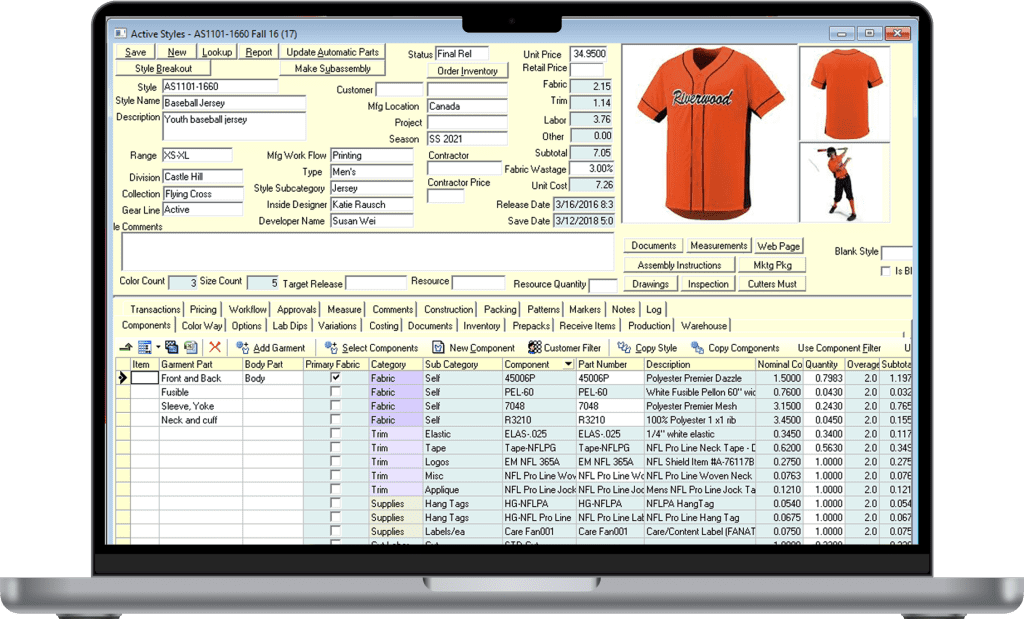
When PLM and ERP share a single database, every update flows instantly across departments, countries, and factories. A unified environment removes sync delays and prevents miscommunication across teams, regardless of whether work is happening in the U.S. or nearshore regions.
A unified platform aligns:
• Teams working across U.S. regions such as Los Angeles, New York, Miami, Chicago, Houston, and Greenville
• Teams operating in or expanding into nearshore markets including Guatemala, Honduras, El Salvador, and Nicaragua
• Design, development, costing, planning, and production teams spread across multiple locations
• Cross-functional groups that rely on accurate, real-time updates regardless of where they are based
• Organizations coordinating multiple facilities, product lines, or time zones
• Internal teams that require consistent data across departments and regions
With real-time data sharing, companies eliminate:
• Manual duplication
• Version mismatches
• Inaccurate POs
• Delayed production handoffs
• Incorrect cut plans
• Last-minute corrections
• Chaos caused by outdated files
Cross-border workflows become far smoother and more predictable.
As styles evolve, BOMs must update right away. Apparel manufacturing ERP software automatically synchronizes changes across costing, purchasing, planning, and production, critical for global sourcing and fast turnaround.
Dynamic BOMs support real-time updates for:
• Fabric substitutions
• Trim changes
• Colorway additions
• Embellishment adjustments
• Customer-specific requirements
• Compliance for major brands
Automated variation logic supports:
• Complex textile and sewn-goods programs across apparel, uniforms, home textiles, and industrial products
• High-variation orders such as teamwear, roster-based programs, and multi-option product lines
• Custom and made-to-order workflows requiring precise specifications and rapid updates
• Corporate, promotional, and private-label programs spanning multiple product categories
• Swimwear, athleisure, performance textiles, and other materials with unique technical requirements
• Embellished and decorated products requiring artwork rules, placements, numbering, and decoration logic
• Multi-fabric or multi-component constructions produced in diverse regions, including nearshore markets such as Guatemala, Honduras, El Salvador, and Nicaragua
This eliminates weeks of manual setup for high-volume, high-variation programs.
→ Explore PolyPM variation automation with an expert
Most ERPs rely on outdated capacity estimates. Apparel teams need SAM-driven accuracy.
SAM-based scheduling provides:
• Accurate production commitments
• Reliable line balancing
• Predictable lead times
• Production slow-down detection
• Reduced overtime
• Better cross-border coordination
This improves planning for:
• Multi-line, multi-facility production environments
• High-variation, fast-turn manufacturing
• Small-batch, made-to-order, and sample-driven workflows
• Categories requiring embellishment, artwork rules, or customization
• Operations spanning multiple product types, materials, or regions
True bundle tracking is essential wherever production happens, Los Angeles, Chicago, Houston, or Central America.
Bundle-level WIP tracks:
• Every operation
• Every bundle
• Every operator
• Every handoff
• Every subcontractor
• Every delay
Supervisors gain visibility into:
• Lines that are behind
• Bundles stuck in process
• Operator or machine problems
• Whether today’s production plan will ship on time
• Where additional support is needed
This level of transparency supports teams working across different U.S. and nearshore regions by reducing errors and preventing costly unexpected surprises.
Fabric optimization becomes even more important when cutting and sewing occur in different facilities or production stages.
Integrated cut planning supports:
• Marker efficiency
• Shrink management
• Roll allocation
• Layer counts
• Dye-lot control
• Cut-ticket generation tied to WIP
• Real-time material usage
This helps manufacturers reduce waste in:
• Manufacturers operating across major U.S. regions such as Los Angeles, Miami, Greenville, Chicago, and Houston
• Teams managing textile, apparel, or sewn-goods workflows in diverse facility types
• Organizations working across multiple production stages or material types
• Companies operating in or sourcing from regions including Guatemala, Honduras, El Salvador, and Nicaragua
• Operations requiring consistent material usage accuracy across distributed teams
Traceability and vendor automation have become essential for manufacturers managing complex materials, multiple production stages, and diverse teams across different regions.
A modern apparel manufacturing ERP software platform provides:
• ASN-based receiving
• API-driven purchase orders
• Real-time vendor acknowledgments
• Automated compliance and documentation checks
• Full roll-to-finished-good traceability across every step in the process
Comprehensive traceability benefits companies working across a wide range of locations, whether their teams, facilities, or workflows are based in:
• U.S. regions such as Los Angeles, Miami, Greenville, Chicago, Houston, or New York
• Nearshore geographies such as Guatemala, Honduras, El Salvador, or Nicaragua
• Multi-stage environments where materials move through development, testing, cutting, sewing, embellishment, or finishing
• Organizations managing multiple product categories and production models
• Teams requiring consistent, real-time visibility across departments and regions
The result is a fully connected, verifiable record of every material, process, and update, without relying on spreadsheets or manual tracking.
PolyPM supports the full spectrum of apparel, sewn-goods, and advanced textile workflows, including:
• Denim, casual wear, and multi-style fashion programs
• Luxury, designer, couture, and sample-room development
• Swimwear, athleisure, activewear, and decorated or embellished categories (including patches, numbering, and artwork placements)
• Technical textiles and performance fabrics such as moisture-management, fire-resistant, antimicrobial, or compression materials
• Industrial and engineered textiles including filtration fabrics, coated materials, laminates, and nonwovens
• Home and lifestyle textiles such as cushion covers, upholstery components, soft goods, and interior fabric products
• Safety and medical textiles including PPE components, clean-room materials, and specialty composites
• Uniforms, workwear, corporate apparel, and regulated garment programs
• High-variation, multi-fabric, and configuration-heavy manufacturing environments
PolyPM’s unified PLM+ERP foundation ensures every category, from fashion apparel to engineered materials, soft goods, and specialized textiles, benefits from real-time accuracy, automated updates, and production-grade intelligence.
→ Don’t see your product category listed? Contact us today to confirm whether PolyPM can support your manufacturing needs.
Whether teams operate in a single facility or across multiple regions, success depends on eliminating disconnected systems and working from a unified, real-time platform. Apparel manufacturing ERP software is no longer optional; it has become the foundation for managing high-variation products, complex workflows, and rapid production cycles.
PLM and ERP must function as one system. Anything less is too slow for today’s industry.
→ Learn more about our PLM and ERP platform PolyPM today with one of our experts
→ Follow us on LinkedIn and Facebook for more updates on apparel manufacturing
Apparel manufacturing ERP software benefits any company producing apparel, sewn goods, or advanced textiles. This includes brands and factories in major U.S. regions such as Los Angeles, New York, Miami, Chicago, Houston, and Greenville, as well as organizations with additional facilities in regions like Guatemala, Honduras, El Salvador, or Nicaragua. These are examples only, of course. The system supports companies of all sizes and structures.
Apparel manufacturing ERP software keeps all departments aligned by providing one source of real time data. Teams in different facilities can share accurate information instantly, eliminating version conflicts, spreadsheet reliance, and delays caused by disconnected tools.
Yes. The system synchronizes BOMs, artwork rules, costing, material usage, size curves, and production updates across all locations. Every team sees changes immediately with no manual reentry.
It automates variation logic, artwork rules, numbering systems, and material consumption calculations. This is essential for categories involving multi panel or multi fabric construction, decorated products, uniforms, teamwear, swimwear, athleisure, and anything with many style or configuration options.
ERP provides dye lot control, fiber and material tracking, lab test documentation, compliance management, and end to end traceability. These capabilities are critical for engineered materials, medical textiles, performance fabrics, and specialty composites.
Yes. ERP enables predictable scheduling, bundle level WIP visibility, accurate capacity planning, and automated handling of large configuration matrices found in uniforms and corporate apparel programs.
Yes. The system captures roll usage, marker assignments, yield data, WIP movement, operator activity, and shipping history. This creates a complete audit trail for quality, sustainability, and compliance initiatives.
Yes. The architecture supports distributed teams, multi facility environments, and organizations managing both fashion and advanced textile programs. All workflows run from synchronized, real time data.
Costs vary based on product complexity, workflow volume, and the number of facilities. Implementations are typically phased so production continues without downtime. For a custom demo, detailed pricing, or an implementation timeline, contact an expert here!