
Selecting the right ERP for the fashion industry in 2026 has become one of the most consequential operational decisions a garment, apparel, and clothing manufacturer can make. Fashion manufacturers across swimwear, activewear, luxury, and fast fashion are operating in environments where product changes are constant, variation is high, and production timelines compress without warning. The question is no longer whether you need an ERP for the fashion industry. The question is whether your system was actually built for fashion manufacturing execution or whether it continues to pushes your team back into spreadsheets every time production gets complex.
The pain points driving garment manufacturers to search for a better ERP for the fashion industry are consistent across every segment:
Whether you are producing a swimwear program with multiple placement rules, a roster-based activewear line, a luxury collection with strict compliance specs, or a high-volume fast fashion run with tight turnaround windows, these problems cost margin. And they get worse if your fashion ERP was designed for finance, and not for the cutting floor.
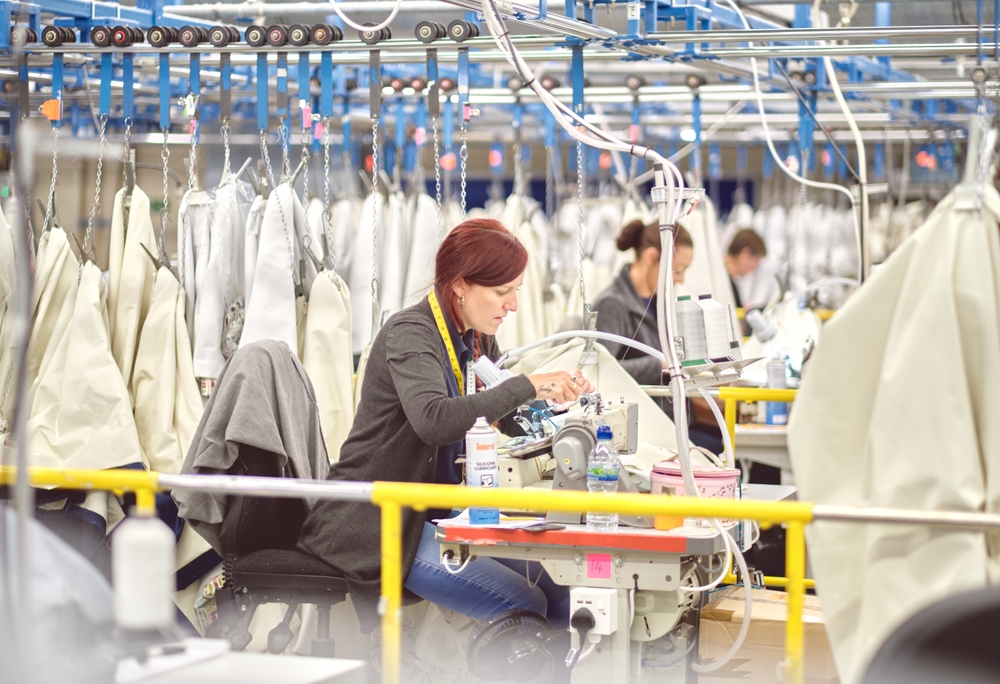
Most ERP platforms are strong in accounting, reporting, and order management. That is not where fashion manufacturing complexity lives.
Complexity in clothing production emerges in execution, in variation logic, decoration scheduling, BOM changes mid-run, and the moment a fabric is substituted and nothing downstream updates automatically.
Generic ERP systems were not designed to handle:
When these workflows are pushed outside the ERP for the fashion industry, operations become dependent on manual coordination. That is when errors multiply and margins erode.
The production reality for apparel manufacturers in 2026 has fundamentally changed. Across every segment, the demands on ERP for the fashion industry are more intense than ever.
Swimwear programs often carry dozens of colorways, multiple embellishment placements, and customer-specific labeling requirements — all within a single seasonal collection.
Activewear and sportswear lines run roster-based programs with numbering logic, configuration-heavy decoration, and fast turnaround cycles tied to team or event schedules.
Luxury and high fashion manufacturers deal with strict compliance specifications, premium material traceability, and the need for flawless tech pack execution from design through delivery.
Fast fashion operations face the opposite pressure: maximum volume, minimal lead time, and constant style refreshes that require BOMs, costing, and production to update without delay.
Manufacturers operating in Los Angeles, New York, Miami, Chicago, Houston, and Greenville – and across nearshore production centers in Guatemala City, San Pedro Sula, Tegucigalpa, San Salvador, and Managua – are navigating all of these pressures simultaneously. No generic apparel manufacturing platform handles them without significant customization. And customization in a generic ERP creates fragility – every upgrade becomes a risk.
One of the most critical structural decisions when evaluating an ERP for the fashion industry is whether your PLM and ERP operate as a unified system or as separate platforms.
When they are separate, garment, apparel, and clothing teams spend significant time re-entering data between product development and production. That creates version conflicts, incorrect cut plans, outdated specs reaching the floor, and delays that compound across the season.
A unified PLM + ERP structure eliminates that gap entirely:
For fashion manufacturers, this is not a nice-to-have. It is the structural foundation that determines whether your ERP for the fashion industry actually runs production, or just reports on it.
Decoration is not an add-on in fashion manufacturing. Embroidery, screen printing, sublimation, and heat transfer are core production steps – and they need to be scheduled, tracked, and costed inside the ERP for the fashion industry, not managed in a separate tool or spreadsheet.
The same applies to cut and sew. When cut planning is disconnected from inventory and WIP, teams cannot see what is actually sewable versus what is theoretical. Mid-run shortages, last-minute adjustments, and dye-lot mismatches become routine instead of exceptions.
This is equally true across adjacent categories. Workwear and uniform programs carry configuration-heavy decoration and compliance specs. Footwear programs manage material convergence late in assembly. Swimwear operations run high-variation embellishment across tight seasonal windows. In every case, an efficient ERP for the fashion industry must treat decoration and cut & sew as native manufacturing workflows, not bolt-on modules.
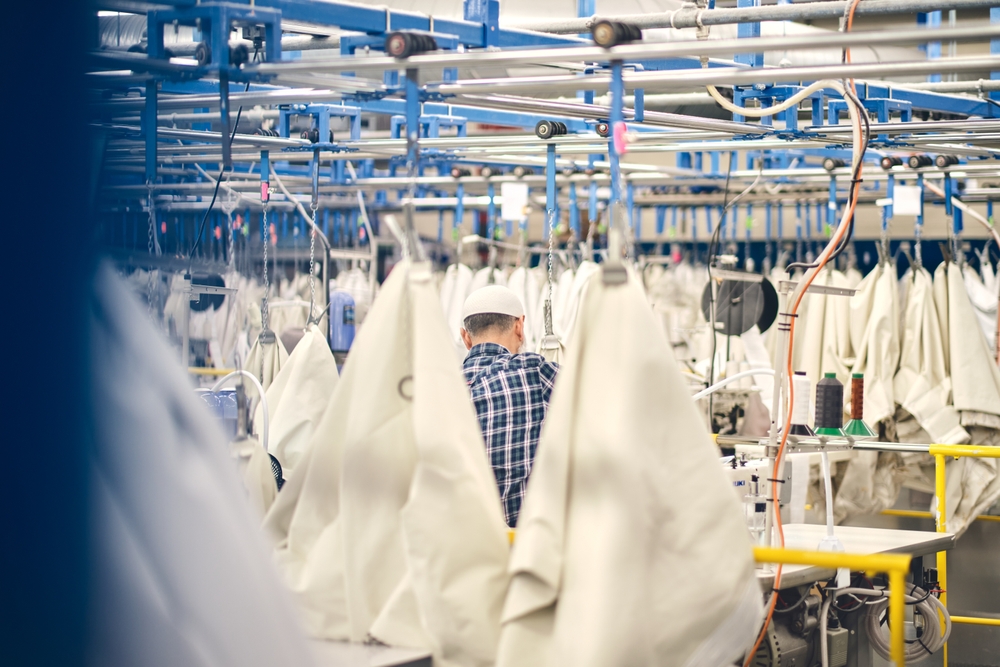
Work in progress in garment manufacturing moves through cut, bundle, sew, embellish, finish, pack, and ship. Without bundle-level visibility at every stage, supervisors cannot see where production is slowing, whether an order will ship on time, or where a subcontractor handoff has stalled.
Most ERP systems report on production after the fact. A true ERP for the fashion industry tracks what is actually happening on the floor, in real time, so teams can act before schedules slip and margins erode.
PolyPM, developed by Polygon Software since 1986, was built specifically for garment and textile manufacturing. It operates as a unified PLM + ERP platform on a single database – meaning product data, production workflows, inventory, variation logic, decoration scheduling, and real-time WIP tracking remain fully aligned without manual re-entry.
For fashion manufacturers across swimwear, activewear, luxury, and fast fashion – and for adjacent programs in workwear, footwear, and swimwear – PolyPM delivers the execution depth that generic ERP systems cannot replicate.
PolyPM supports the full value chain:
PolyPM customers also upgrade version to version without reimplementation: no disruptive redevelopment projects, no production downtime, no loss of custom workflows. For fashion manufacturers evaluating long-term ERP stability, that matters as much as features.
PolyPM also integrates with QuickBooks, Microsoft Office, Adobe applications, and Windows-compatible software, allowing teams to maintain existing workflows while centralizing product data, production, and execution in one system.
The right ERP for the fashion industry is not the one with the longest feature list. It is the one that continues to function when production becomes complex: when variation multiplies, specs change mid-run, decoration needs to ship on time, and your teams are spread across different regions.
PolyPM was built for exactly that environment: for clothing manufacturers who cannot afford to have production running outside their ERP.
Follow PolyPM on LinkedIn and Facebook for more insights on ERP for the fashion industry. Read verified PolyPM reviews on Capterra.
What is an ERP for the fashion industry? An ERP for the fashion industry is a software platform designed to manage and integrate core operational processes specific to apparel manufacturing – including production, inventory, sourcing, order tracking, decoration, and shipping. Unlike generic ERP systems, a purpose-built ERP for the fashion industry keeps product data, BOM changes, and production execution aligned in real time across every department and facility.
How is PolyPM different from generic ERP systems for fashion manufacturing? PolyPM operates as a unified PLM + ERP platform built on a single shared database. Instead of separating product development and production into different systems, PolyPM connects product data, inventory, costing, production planning, decoration scheduling, and order management inside one environment. When a change is made anywhere in the database, it is instantly available across all authorized users, without manual re-entry, version conflicts, or syncing delays. Generic ERP systems are not designed to work this way.
Does PolyPM support decoration as part of the manufacturing workflow? Yes. PolyPM treats decoration – including embroidery, screen printing, and sublimation – as a native production step, not an external or outsourced workflow. Decoration is scheduled, tracked, and costed inside the same system as cut and sew operations. This is critical for fashion manufacturers running swimwear programs with multiple embellishment placements, activewear lines with numbering logic, or workwear programs with compliance-driven decoration requirements.
Can PolyPM handle high variation across fashion segments? Yes. PolyPM was built specifically to manage high-variation garment, apparel, and clothing programs. Its automated variation logic supports fabric substitutions, trim changes, colorway additions, embellishment adjustments, customer-specific requirements, and compliance-driven modifications – all synchronized automatically across costing, purchasing, planning, and production. When variation logic collapses in a generic ERP, teams revert to spreadsheets. PolyPM was designed to prevent exactly that.
Does PolyPM support manufacturers operating across multiple regions? Yes. PolyPM supports distributed garment, apparel, and clothing manufacturing operations across major U.S. production hubs including Los Angeles, New York, Miami, Chicago, Houston, and Greenville, as well as nearshore regions such as Guatemala City, San Pedro Sula, Tegucigalpa, San Salvador, and Managua. Because PolyPM operates on a single shared database, product data, production workflows, and inventory remain aligned across all facilities and teams in real time.
Does PolyPM require reimplementation during upgrades? No. PolyPM customers upgrade version to version without reimplementation, without external redevelopment projects, and without production disruption. Custom workflows remain intact and manufacturing continues uninterrupted. For fashion manufacturers evaluating long-term ERP stability, this is a critical differentiator compared to generic platforms that often require disruptive upgrade cycles resembling full system replacements.
Can PolyPM integrate with existing tools and software? Yes. PolyPM integrates with QuickBooks, Microsoft Office, Adobe applications, and Windows-compatible software. This allows clothing teams to maintain existing workflows while ensuring product data, documents, and production information remain centralized and accessible inside one system.